
close
Choose Your Site
Global
Social Media

Views: 0 Author: Site Editor Publish Time: 2026-10-03 Origin: Site


Under-specifying a test chamber carries hidden risks. Inadequate cable routing or blocked airflow quickly invalidates critical test data. Such oversights inevitably delay vital product qualification schedules. At the procurement stage, teams usually prioritize standard chamber specifications. Temperature ranges and cooling ramp rates get all the attention. Meanwhile, crucial add-ons become mere afterthoughts. This mindset creates severe operational bottlenecks down the line. We must frame the selection of environmental test chamber accessories differently. It is not just a basic catalog exercise. It demands critical alignment with specific goals. You must match these choices perfectly to your Device Under Test (DUT) requirements. Facility limitations and future testing scopes play major roles too. In this comprehensive guide, you will learn how to configure your chamber for maximum reliability. We will explore essential feedthroughs, robust shelving setups, and advanced safety mechanisms. Read on to discover how smart accessory choices protect testing integrity.
Feedthroughs dictate test validity: Incorrectly sized or poorly insulated ports cause thermal bridging, leading to inaccurate readings and condensation risks.
Airflow is non-negotiable: The right test chamber sample fixtures ensure uniform temperature distribution; improper shelving creates dead zones.
Factory-installed vs. Retrofit: Core structural accessories (like heavy-duty flooring or custom viewing windows) must be specified upfront, as field retrofitting is highly disruptive and compromises chamber integrity.
Safety and Compliance: Purge systems and safety interlocks are strict necessities, not optional upgrades, for live-load testing or volatile DUTs.
The core problem often starts by utilizing a bare-bones chamber. Engineering teams attempt to test complex electronics or heavy mechanical components without proper structural support. This misguided approach leads directly to makeshift cable routing. For instance, an operator might run thick power wires directly through the main door seal. Such dangerous shortcuts destroy thermal isolation instantly. They compromise the entire test environment. When you break the seal, outside ambient air rushes in. This unconditioned air disrupts the internal climate dynamics completely.
Data integrity suffers immediately under these poor conditions. Leaky access ports cause unpredictable temperature gradients across the workspace. These unwanted variations easily fall outside strict MIL-STD or IEC compliance tolerances. A failure to hold a precise temperature profile invalidates hours of expensive testing. Furthermore, operational efficiency drops sharply. A lack of proper shelving increases setup and teardown times immensely. Technicians spend hours reconfiguring batches instead of actively running tests.
You should assess all chamber additions based on three main pillars. First, consider your specific DUT connectivity needs. Look closely at every required wire and pneumatic hose. Second, evaluate thermal uniformity requirements. Keep conditioned air moving smoothly around the product. Finally, prioritize operator safety above all else. Avoid cutting corners during the specification phase. Proper configuration guarantees reliable, repeatable testing outcomes every single time.
How do you evaluate access points effectively? You need them to route power, sensor cables, and pneumatics safely. However, you absolutely cannot compromise the climatic seal. Evaluating your options early prevents massive operational headaches later. Let us explore the right configurations for your specific application.
Standard round ports typically range from two to six inches in diameter. They work exceptionally well for standard thermocouple and basic power routing. You should always include high-quality standard silicone plugs. These flexible plugs fill the empty space around your wires securely. Notch ports offer a very different operational advantage. Manufacturers build them directly into the solid door frame. You will find them essential for rapid loading scenarios. They let you move pre-wired DUTs quickly into the workspace. You never have to disconnect complex multi-pin connectors. This feature saves tremendous setup time between large batches.
Condensation management requires careful upfront planning. You must evaluate the need for heated port plugs carefully. They actively prevent exterior sweating during extreme cold-soak cycles. Moisture buildup outside the chamber creates severe slipping hazards on the floor. It also damages nearby sensitive laboratory equipment. Placement strategy matters just as much as the port type. Specify left versus right wall placement carefully. Base this crucial decision on your existing facility floor plan. Also consider the internal airflow direction. Properly placed environmental chamber feedthrough ports prevent thermal bridging entirely. They keep the chamber fully sealed and performing optimally.
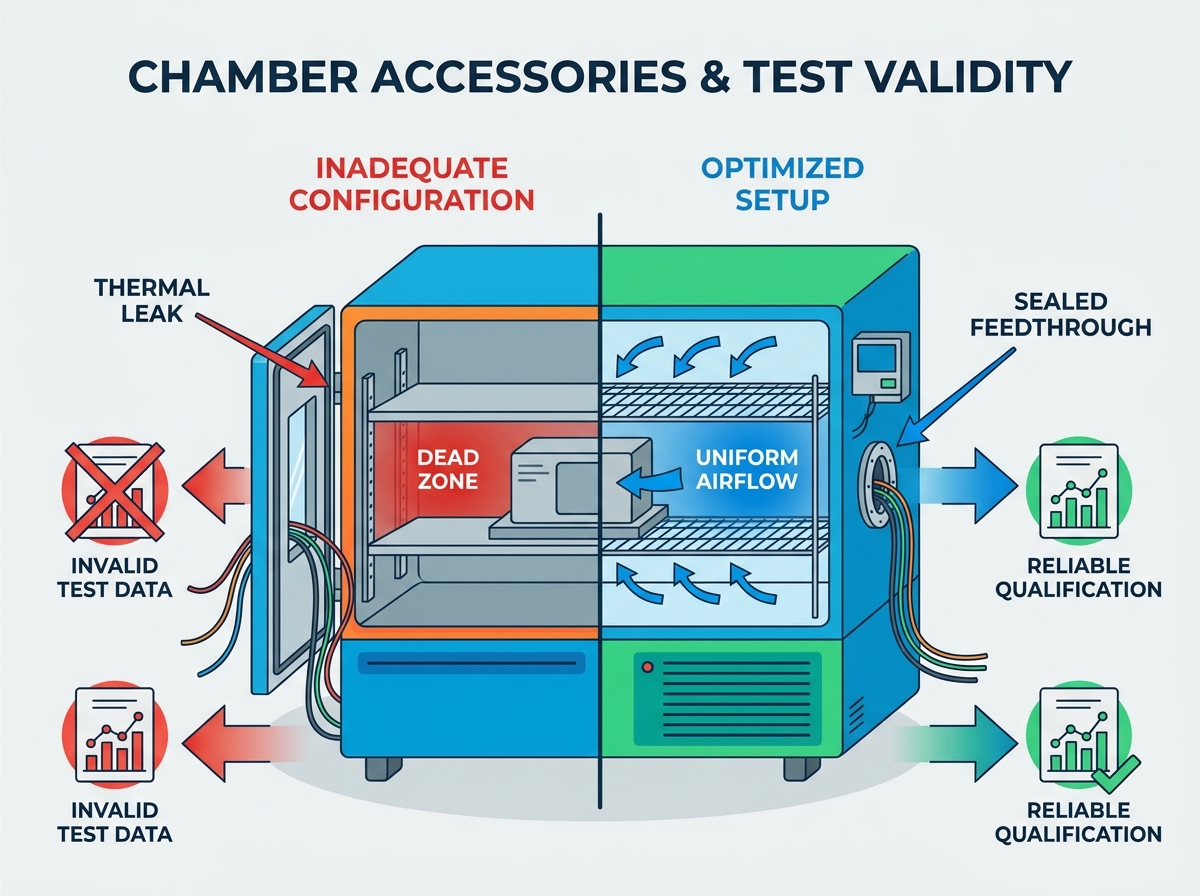
Outcome mapping remains a crucial step before purchasing. You must select fixtures safely supporting the DUT's full weight. These fixtures must never obstruct the internal aerodynamic design. Bad material choices disrupt airflow and heavily skew test results. We see this costly mistake often in busy test labs.
Consider wire grates versus solid punched shelves. Wire grates remain absolutely mandatory for high-velocity vertical airflow. Conditioned air easily passes through them. Solid shelves create massive thermal shadow zones underneath. They block conditioned air from reaching the product evenly. This creates hidden hot spots. Next, thoroughly evaluate slide-out racks. Slide-out mechanisms assist greatly when handling heavy or awkward DUTs. They improve operator ergonomics significantly. Technicians avoid painful back injuries. They also heavily reduce costly product drop risks during loading.
Heavy-duty flooring becomes strictly necessary for testing massive machinery. Prime examples include dense EV batteries and large engine blocks. Standard thin floors buckle under such intense point loads. Proper flooring upgrades prevent localized floor buckling entirely. They also stop the sub-floor insulation from crushing under extreme weight. Crushed insulation destroys the chamber's thermal efficiency permanently. Consider specialized test chamber sample fixtures too. Custom-machined mounting brackets securely hold high-vibration components. They are completely vital inside combined environment testing units. They ensure the product stays safely anchored during violent shaking.
You need a clear decision framework here. Differentiate carefully between basic baseline operational items and aggressive testing add-ons. Standard operation requires minimal intervention. Extreme testing pushes machinery to its absolute limits.
Dry air purge systems utilize GN2 or specialized desiccant. They prove extremely critical during ultra-low-temperature testing profiles. They prevent dangerous frost build-up directly on the DUT. Frost acts as an unwanted insulator and ruins thermal conductivity. Purge systems also keep vital cooling coils entirely clear during rapid thermal transitions. Water purification systems matter just as much for humidity models. Demineralizer cartridges or reverse osmosis systems help immensely. They prevent stubborn mineral scaling inside sensitive humidity generators. Scaling destroys heater elements and clogs fine atomizing nozzles quickly.
Sometimes traditional mechanical refrigeration falls short. Liquid Nitrogen (LN2) or CO2 boosts effectively fill this performance gap. Evaluate these powerful add-ons for specific stress-screening standards. They achieve the exceptionally rapid pull-down rates required by ESS. They also handle rigorous HALT/HASS testing profiles smoothly. Mechanical compressors simply cannot drop temperatures fast enough for these specific standards. The boost system injects expanding gas directly into the workspace. This action forces the temperature down in mere seconds.
Chamber Accessory Comparison Chart
Accessory Category | Baseline Requirement | High-Performance Testing Need |
|---|---|---|
Airflow Management | Standard Wire Grates | Custom Slide-Out Racks |
Port Configuration | 2" Round Ports | Door Frame Notch Ports |
Moisture Control | Standard Humidity Control | GN2 Dry Air Purge |
Cooling Systems | Mechanical Refrigeration | LN2/CO2 Boost Systems |
Risk mitigation actively protects everyone in the facility. Proper enhancements safeguard equipment operators, the expensive DUT, and the entire lab environment. Ignoring these critical safety features leads to catastrophic accidents.
Clear visibility remains a top operational priority. Heated viewing windows represent an essential investment here. They utilize multi-pane, vacuum-sealed, and electrically heated glass. This specialized glass monitors DUTs during deep freeze cycles without fogging up. Standard glass frosts over instantly at negative temperatures. Glove ports also provide tremendous practical value. Evaluate them for unique applications requiring physical manipulation. They let technicians handle the DUT directly without ever breaking the climate seal. You maintain the set temperature while adjusting switches or moving probes.
Safety compliance interlocks prevent disastrous laboratory events. Gas monitors and dedicated alarms are strictly mandatory. You desperately need them when testing volatile components. Lithium-ion batteries often outgas dangerous chemicals before thermal runaway. Do not overlook critical emergency stop (E-Stop) buttons. You must place them within easy reach. Pressure relief vents also add crucial structural protection. They prevent catastrophic failure during rapid thermal expansion. They handle unexpected DUT combustion by safely venting excess pressure outside the chamber.
The "Factory vs. Field" rule strictly guides your purchasing timeline. Some items require immediate factory integration. Others can easily wait for later field installation. Understanding this distinction saves you immense frustration. Factory installations happen before the chamber walls are sealed. Field retrofits require cutting into finished panels.
Specify these items immediately:
Order heated viewing windows upfront.
Include extra side feedthrough ports immediately.
Request heavily reinforced floors early.
Specify mechanical compressor upgrades before the build starts.
Retrofitting structural elements breaks vapor barriers. It destroys insulation integrity. It also aggressively voids most manufacturer warranties.
Buy these items later:
You can easily add extra standard wire shelves later.
External chart recorders remain simple field additions.
Replaceable water filters and external tanks also fall into this category.
Compile a comprehensive master list first. Document all external power cords, delicate sensor wires, and heavy mechanical loads. Note your exact required regulatory test standards.
To ensure integration success, follow these exact steps:
Inventory every single power cord and sensor wire bundle.
Calculate the absolute total mechanical load of your heavily loaded DUT.
Identify all required MIL-STD or IEC regulatory test standards.
Submit this detailed list during the initial manufacturer quoting phase.
Providing this list early ensures entirely correct port mapping. It also guarantees proper internal fixture sizing.
Properly specified configurations completely transform a generic testing box. They turn it into a highly precise qualification tool. It becomes a deeply reliable asset for your busy laboratory. You must prioritize add-ons protecting thermal integrity first. High-quality ports and properly fitted plugs matter immensely. Airflow protection through smart shelving and specialized fixtures remains equally vital. These elements guarantee highly accurate, highly repeatable test data.
Do not treat these structural components as optional secondary choices. We highly recommend consulting an experienced application engineer early. Have them review your specific DUT thoroughly. Discuss your exact aggressive test profiles openly. Execute these crucial steps before finalizing your important chamber purchase order.
A: Yes, but it is highly discouraged. Drilling into a chamber post-manufacturing risks puncturing refrigerant lines. It completely destroys the fiberglass insulation barrier. This action permanently compromises the moisture vapor seal. Always specify your required ports at the time of order.
A: Utilize tightly fitted silicone port plugs customized to the exact cable bundle diameter. For extreme temperature gradients, specify mechanically compressed foam inserts. Heated port surrounds also effectively mitigate severe thermal leaks and prevent exterior condensation.
A: Yes, if your testing involves dropping to sub-freezing temperatures. Even standard ambient lab air contains moisture. A dry air purge forces this moisture out entirely. It actively prevents dangerous frost from forming on the DUT or the chamber evaporator coils.
A: Standard wire-mesh shelving typically holds 35–50 lbs uniformly distributed. For higher weights, heavy-duty shelving supports up to 150+ lbs. Reinforced chamber floor grates are absolutely required for massive loads to avoid bending tracks or permanently blocking airflow.


