
close
Choose Your Site
Global
Social Media

Views: 0 Author: Site Editor Publish Time: 2026-10-26 Origin: Site


Selecting the wrong thermal analysis method brings high stakes to polymer characterization. You risk compliance failures, downstream product defects, and misallocated laboratory resources. Material scientists and quality managers must get this decision right to protect product integrity. Both methods measure thermal properties, yet they capture fundamentally different data sets. One tracks heat flow. The other monitors mass change. You cannot treat these techniques as interchangeable.
We built this evaluation framework to guide your technology selection process. It helps R&D teams, QA/QC departments, and laboratory managers make precise, informed decisions. You will learn how to align your specific testing goals and operational realities with the correct analytical instruments. Let us explore how to safeguard your polymer formulations, meet stringent industry standards, and streamline your material testing workflows effectively.
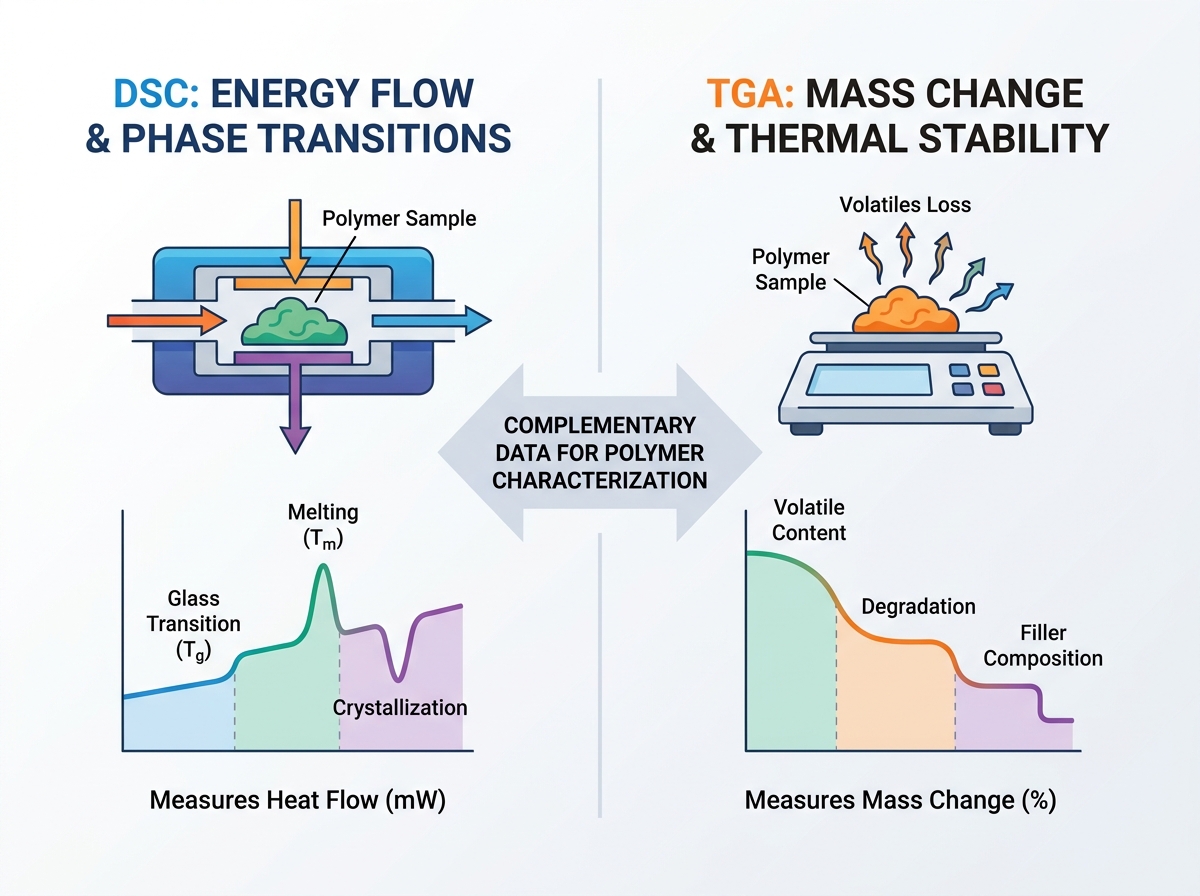
DSC focuses on energy: It identifies phase transitions (glass transition, melting, crystallization) without mass loss, crucial for processing and performance parameters.
TGA focuses on mass: It measures weight changes over temperature, essential for determining thermal stability, volatile content, and filler composition.
Complementary, not interchangeable: Many compliance standards require both; choosing one depends strictly on whether your primary risk is thermal degradation or phase behavior.
Implementation reality: Sample preparation, crucible selection, and baseline calibration often dictate the practical throughput of these instruments in a commercial lab.
Laboratory managers frequently face difficult choices when upgrading analytical capabilities. Choosing the incorrect thermal analysis technique often leads to severe blind spots in material characterization. These blind spots directly translate into manufacturing failures. Understanding the business implications of this choice ensures your lab supports broader company objectives.
Incomplete thermal data creates massive downstream vulnerabilities. If your lab misses a subtle glass transition event, engineers might specify an injection molding temperature that causes post-mold warping. Conversely, failing to detect early-stage volatile loss can lead to off-gassing during extrusion. This trapped gas creates structural voids in the final product. You must align the physics of your testing method with the specific failure modes your product faces in the real world.
Modern supply chains demand strict adherence to international testing standards. Aerospace, automotive, and medical device manufacturers cannot accept raw materials without certified thermal data. You must demonstrate compliance with specific protocols. For example, testing labs routinely use ASTM D3418 to govern thermal transition measurements in plastics. Meanwhile, ASTM E1131 dictates the procedures for compositional breakdown via mass loss. Investing in the wrong instrument prevents your facility from issuing valid certificates of analysis for these critical sectors.
Laboratory space, analyst time, and initial capital expenditures represent significant constraints. You must decide whether your testing volume justifies purchasing standalone units or if you should rely on outsourced material testing partners. High-volume manufacturing environments usually require dedicated, in-house capabilities to maintain production speed. Alternatively, specialized R&D teams dealing with unpredictable sample types might initially leverage third-party labs before committing large capital budgets to specialized instrumentation.
Differential Scanning Calorimetry represents the foundation of modern polymer characterization. It provides unmatched visibility into the molecular mobility and phase transitions of plastic materials. Understanding its core mechanics helps you determine if it fits your analytical requirements.
This technique measures heat flow into or out of a sample as a function of temperature or time. The instrument places your polymer sample and an empty reference pan inside a precisely controlled furnace. As the temperature rises, the system monitors the energy required to keep both pans at the exact same temperature. Endothermic events, like melting, require more energy. Exothermic events, like curing, release energy. The resulting thermogram maps these energy shifts.
DSC dominates when you need to understand physical state changes. It excels at determining the Glass Transition Temperature (Tg) and Melting Point (Tm) of thermoplastics. For thermosetting polymers, analysts use it to evaluate the degree of crystallinity and monitor complex curing kinetics. When analyzing materials, assessing the processing parameters of differential scanning calorimetry plastics reveals critical behavioral insights. Engineers rely on this specific data to optimize extrusion speeds, mold temperatures, and cooling rates.
You must recognize the strict operational demands of this technology. Meticulous sample preparation remains non-negotiable. Analysts must cut samples to ensure perfectly flat bottoms. You must also select and seal specific aluminum or platinum pans carefully. Poor thermal contact between the sample and the pan ruins data resolution.
Furthermore, this method cannot determine compositional breakdown. It detects energy shifts, not missing mass. A severe operational hazard exists here. Heating an unknown polymer past its degradation temperature will cause it to decompose, release corrosive gases, and permanently destroy the highly sensitive heat flow sensors.
When physical transition data is insufficient, scientists turn to mass-based evaluation. This technique physically weighs materials as they burn, evaporate, or decompose, providing an exact compositional map of complex formulations.
This technology continuously measures sample mass loss or gain as a function of temperature and atmosphere. The core mechanism involves a highly sensitive microbalance suspended inside a programmable furnace. As the system heats the sample, purge gases sweep away evolved volatiles. The microbalance records the exact microgram-level weight changes in real-time, producing a degradation curve.
Labs routinely conduct thermogravimetric analysis of polymers to determine absolute thermal stability and maximum safe operating limits. This testing isolates precisely when a material begins to fail under heat stress. Beyond basic stability, scientists use it to quantify filler content (like glass fibers or carbon black), plasticizers, flame retardants, and trapped moisture. It also serves as a powerful reverse-engineering tool. By carefully managing the heating rate and switching from inert nitrogen to reactive oxygen atmospheres, analysts can forcefully separate and identify different components within a competitor's proprietary blend.
Despite its analytical power, the technique has firm physical limitations. It remains completely blind to non-mass-changing thermal events. The instrument will not detect glass transitions, standard melting points, or cold crystallization because these events do not alter the sample's weight.
Operationally, analysts must actively manage buoyancy effects. As furnace temperatures rise, the density of the surrounding purge gas drops. This physical change can cause the microbalance to register a false mass gain. Laboratories must implement strict baseline subtraction protocols, running empty crucibles to correct these gas flow and buoyancy variations.
Deciding between DSC vs TGA for polymers requires a clear understanding of your specific material questions. We evaluate these technologies across several operational dimensions to help you align them with your laboratory goals.
The primary distinction lies in the analytical intent. Choose heat flow techniques when you need to understand how a polymer will behave during processing. If you want to know how much energy it takes to melt a pellet, or at what temperature a molded part will soften, measure the energy changes. Conversely, choose mass loss techniques to understand what a polymer is made of and when it will permanently degrade. If you must verify the exact percentage of glass fiber reinforcement or prove a material contains no volatile solvents, measure the mass retention.
High-volume QA environments prioritize testing speed and cycle times. Both methods present unique throughput challenges. Heat flow testing often requires extended cooling times between runs. Labs must integrate external cooling accessories, such as liquid nitrogen pumps or intracoolers, to bring the furnace back to sub-ambient starting temperatures quickly.
Mass loss systems typically cool faster due to their physical design. However, automation poses different risks. Autosamplers on mass loss instruments can fail if highly reactive samples foam and overflow the crucible during rapid decomposition, contaminating the delicate microbalance mechanism. QA managers must strictly control sample sizes when automating these specific tests.
Thermal Analysis Method Comparison
Evaluation Dimension | Differential Scanning Calorimetry | Thermogravimetric Analysis |
|---|---|---|
Primary Measurement | Heat flow (Energy absorption/release) | Mass change (Weight loss/gain) |
Core Polymer Insights | Melting point, Glass transition, Crystallinity | Thermal stability, Filler content, Volatiles |
Failure Mode Detected | Warping, incomplete curing, phase shifts | Off-gassing, degradation, burning |
Atmosphere Control | Usually inert (Nitrogen) to prevent burning | Dynamic (Nitrogen to Oxygen switching) |
Crucible Requirements | Sealed, flat-bottomed aluminum/platinum | Open ceramic or platinum pans |
Many complex characterization scenarios demand insights from both energy and mass perspectives simultaneously. Instrument manufacturers developed specialized combination systems to address this exact requirement in advanced material laboratories.
Simultaneous Thermal Analysis combines both testing methodologies into a single hardware platform. Engineers often refer to these combined units as SDT (Simultaneous DSC-TGA) instruments. They feature a unique dual-sensor design placed inside a single programmable furnace. This allows the system to record weight changes and heat flow variations from a single sample at the exact same moment.
The most significant advantage lies in eliminating sample-to-sample variation. Because you test the exact same physical sample simultaneously, you guarantee identical thermal histories. This makes correlating data exceptionally precise. If the system detects an endothermic peak, the simultaneous mass curve instantly tells you whether that peak represents melting (no mass loss) or evaporation (corresponding mass loss). Furthermore, a combined system dramatically reduces the required laboratory footprint, freeing up valuable bench space.
Despite their appeal, combined units demand engineering compromises. To accommodate the physical microbalance mechanism, the heat flow sensors in an STA system are typically bulkier than those in dedicated standalone units. Consequently, STA systems often sacrifice the ultra-high sensitivity required to detect very subtle glass transitions in highly filled polymers.
Additionally, you must consider operational risk. If the furnace or the software requires maintenance, you lose both testing capabilities at once. Dedicated units provide redundancy; if one instrument goes offline, the other remains fully operational.
Moving from theory to procurement requires a structured decision-making process. Use this sequential logic to narrow down your thermal analysis equipment options effectively.
Define the primary material failure mode. Examine your historical defect data. Are your products failing due to inaccurate processing temperatures and physical warping? If so, prioritize heat flow measurements. Are they failing due to environmental degradation, premature burning, or inconsistent filler ratios? If so, prioritize mass loss measurements.
Audit your compliance requirements. Review your customer contracts and internal quality mandates. Identify exactly which ASTM or ISO standards your lab must satisfy. Regulatory requirements often dictate the specific technology you must deploy, removing the guesswork from the equation.
Evaluate internal expertise. Thermal data interpretation requires skill. Overlapping thermal transitions can confuse inexperienced operators. Assess whether your current team possesses the expertise to manually interpret complex thermograms. If not, look for software-assisted instrument packages that automate peak identification, or consider relying on specialized third-party testing partners.
Actionable Next Step: Do not rely solely on specification sheets. We strongly recommend booking a live demonstration with instrument vendors. Insist on running your own proprietary polymer samples during the demo. Alternatively, request a pilot test from a certified analytical laboratory to validate which data set actually solves your material challenges before making a final commitment.
Choosing the right characterization technology is rarely about finding a universally superior instrument. It is entirely about aligning the physics of the test with the specific commercial and structural risks of your polymer application. You must secure clear visibility into how your materials melt, flow, and eventually degrade.
Apply the framework we discussed to audit your current testing gaps. Focus on your primary failure modes, respect your compliance mandates, and honestly assess your internal analytical capabilities. Contact technical sales teams for a customized consultation on testing equipment. Whether you integrate standalone units, deploy combined systems, or leverage custom material characterization services, securing accurate thermal data remains your best defense against catastrophic material failures.
A: No, it cannot. Glass transition is a physical phase change involving molecular mobility and heat capacity, not a chemical decomposition. Because the polymer’s mass does not change during a glass transition, the microbalance will register nothing. You must use differential scanning calorimetry to detect Tg.
A: Both techniques require very small amounts of material. DSC typically uses 5 to 20 milligrams. Smaller samples ensure better thermal contact and sharper peak resolution. TGA samples range from 10 to 50 milligrams, allowing enough mass to accurately measure subtle percentage drops during volatilization or filler degradation.
A: Thermomechanical Analysis (TMA) measures dimensional stability, tracking how a polymer expands or shrinks under heat. Dynamic Mechanical Analysis (DMA) evaluates mechanical stiffness changes over a temperature range. Long-term oven aging physical tests also assess structural stability over extended periods, complementing the rapid mass-loss data provided by thermogravimetric methods.
A: Laboratories typically calibrate these instruments monthly or quarterly, depending on testing volume and strict ISO/ASTM audit requirements. High-throughput QA environments might run quick temperature verification checks weekly using standard reference materials, like indium, to ensure data remains consistently reliable and audit-ready.


