
close
Choose Your Site
Global
Social Media

Views: 0 Author: Site Editor Publish Time: 2026-10-14 Origin: Site


Material validation carries massive stakes in modern engineering. Standard ambient testing consistently fails to predict how materials behave in operational extremes. Aerospace components face brutal atmospheric re-entry temperatures. Automotive parts must survive unforgiving sub-zero winters. Energy sector infrastructure endures constant thermal cycling. Executing a reliable temperature conditioned tensile test presents significant technical hurdles. Engineers must ensure precise synchronization between thermal chambers, specialized gripping systems, and delicate extensometry. This article provides a comprehensive blueprint for lab managers and engineers. You will learn how to evaluate core equipment and mitigate common implementation risks. We also outline how to establish highly reliable testing protocols. By following these guidelines, you can build a testing environment tailored for demanding applications.
Achieving accurate low temperature material tensile strength data requires managing thermal contraction to prevent grip slippage.
Thermal soaking time is a critical variable; internal core temperature must stabilize to match the chamber's ambient environment before load application.
Equipment evaluation must prioritize integration: the Universal Testing Machine (UTM), environmental chamber, and software must communicate seamlessly to maintain compliance with ASTM/ISO standards.
Standard room-temperature tests often fall short during critical material evaluations. They cannot replicate the harsh realities of extreme operational environments. Components exposed to cryogenic freezing or intense heat behave unpredictably. Ambient tests completely ignore thermal expansion dynamics. They miss vital data points needed for extreme use cases.
Engineers face a distinct testing gap when moving beyond room temperature. Most materials exhibit drastic mechanical shifts across different thermal spectrums. Standard tests assume a stable molecular structure. However, extreme heat relaxes molecular bonds. Cryogenic cold stiffens these exact same bonds. Relying solely on ambient data creates a dangerous knowledge deficit.
Testing at specific operational temperatures reveals hidden failure modes. You must identify these vulnerabilities before manufacturing begins. Common failure evaluations include:
Evaluating brittle fracture risks: Cold environments severely reduce material ductility. Engineers must test for sudden snapping.
Determining yield strength limits: You need precise data to calculate accurate low temperature material tensile strength. Materials often handle less stress before deforming in the cold.
Identifying creep and oxidation: Elevated temperatures introduce entirely different degradation risks. Constant high heat causes metals to slowly stretch or oxidize over time.
Tracking ductile behavior changes: Extreme heat forces solid metals to behave almost like viscous fluids under tension.
The business impact extends far beyond the laboratory environment. Comprehensive testing prevents disastrous field failures. A single catastrophic failure destroys brand trust permanently. Regulatory compliance also mandates rigorous thermal proof. Aerospace and automotive sectors strictly enforce these standards. Furthermore, reliable data accelerates advanced material R&D cycles. You can push innovative products to market much faster. Confident engineering ultimately drives long-term profitability.
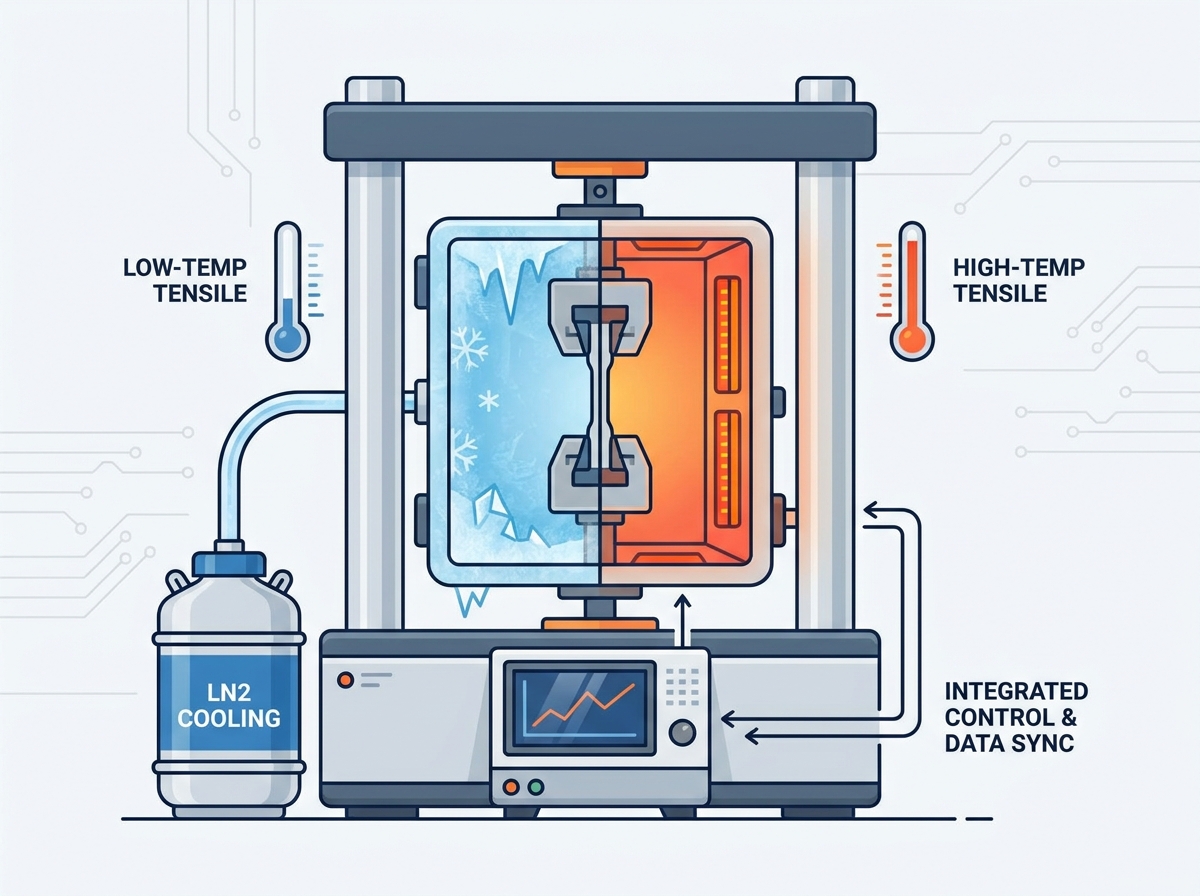
Configuring a system for high low temperature tensile testing requires careful component selection. You cannot simply attach a standard heater to a UTM. True extreme testing demands highly specialized, synchronized hardware.
The environmental chamber acts as the core thermal engine. Cooling mechanisms dictate your lower testing limits. Mechanical refrigeration handles moderate cold testing adequately. However, extreme cryogenic testing requires chemical coolants. Liquid Nitrogen (LN2) or Liquid Carbon Dioxide (LCO2) achieve rapidly dropping temperatures. They sustain these extreme lows reliably.
Heating elements require equally careful selection. Convection heating circulates hot air across the sample. This works well for standard plastics. Radiant heating offers different benefits entirely. It ensures uniform temperature distribution across thick metallic specimens. Both systems demand robust internal insulation to protect surrounding lab equipment.
Mechanism Type | Typical Temperature Range | Primary Application | Key Considerations |
|---|---|---|---|
Mechanical Refrigeration | -40°C to ambient | Automotive components, rubbers | Requires consistent power; slower cooling rates. |
Liquid Nitrogen (LN2) | -150°C to ambient | Aerospace alloys, cryogenic plastics | Requires specialized ventilation and tank storage. |
Convection Heating | Ambient to 300°C | Polymers, standard composites | Air turbulence can affect optical measurements. |
Radiant Heating | Ambient to 1000°C+ | High-performance metals, ceramics | Requires specialized high-temperature grips. |
Standard grips routinely fail under extreme thermal stress. Thermal expansion causes severe sample slippage during hot tests. Conversely, intense cold causes metallic contraction. This leads to premature specimen failure right at the grip face. You must utilize robust gripping solutions for extreme testing.
Engineers typically deploy extended grip rods. These pull the primary gripping mechanism away from the hot zone. High-temperature alloys like Inconel resist deformation under intense heat. Additionally, some setups require active cooling. Active water-cooling protects grip mechanisms located just outside the chamber zone. This prevents heat transfer from reaching the sensitive load cell above.
Measuring strain requires highly specialized extensometers. Standard clip-on devices melt or freeze instantly. High-temperature contact extensometers utilize advanced ceramic rods. These rods reach inside the chamber to touch the sample directly. They relay strain data back to sensors located safely outside.
Non-contact optical or laser extensometers provide modern alternatives. They read specimen deformation through a multi-pane, heated glass window. This mitigates the risk of physical component degradation entirely. It also removes the physical weight of an extensometer from delicate samples.
Planning involves far more than pushing a start button. Execution requires meticulous physical setup. Errors compound rapidly in extreme environments.
You must minimize axial misalignment during the setup phase. Crooked samples produce skewed data instantly. Thermal expansion in the load string exacerbates existing alignment errors. As the pull rods heat up, they expand slightly. This shifts the specimen off-center if not properly secured. Universal joints or self-aligning fixtures help counteract these dynamic shifts.
Establishing required soak times is arguably the most critical step. You cannot apply load the moment the chamber reaches the target temperature. Base your soak times heavily on material thermal conductivity. Specimen thickness also dictates the necessary duration. You must ensure a zero temperature gradient across the entire sample.
The core of the material must match its surface temperature exactly. Rushing this step guarantees faulty data. Thick metals require significantly longer soak protocols than thin plastic films.
Chamber air turbulence negatively affects optical strain measurements. Convection fans move air rapidly to distribute heat. This moving air distorts light waves passing through the observation window. You must account for this distortion in your software algorithms.
Validating your thermocouple placement is equally vital. Surface readings often differ drastically from ambient chamber readings. Attach a secondary thermocouple directly to the specimen surface whenever possible. This provides real-time verification of the actual material temperature.
Relying solely on the chamber's ambient air sensor instead of a sample-attached thermocouple.
Ignoring the thermal expansion of the grip rods, leading to slack in the test setup.
Failing to use heated viewing windows, resulting in fogged glass and failed optical strain readings.
Extreme environment testing operates under strict authoritative frameworks. You must adhere to global standards to ensure data validity. Regulatory bodies reject data produced outside these established parameters.
Industry standards provide explicit roadmaps for testing protocols. You must follow ASTM E21 guidelines for elevated temperature testing. This framework dictates acceptable heating rates and temperature tolerances. ISO 6892-2 dictates similarly crucial parameters for international compliance.
Engineers often must adapt standard ASTM E8/E8M methodologies. These standard rules form the baseline for all tensile testing. However, extreme temperatures require specific adaptations regarding strain rates and soaking durations. Familiarize yourself deeply with these specific standard appendices.
Rigorous calibration separates professional labs from amateur setups. Simultaneous calibration is strictly non-negotiable. You must calibrate the load cell and the thermal chamber together. Changing temperatures affect load cell sensitivity dynamically. You must account for this drift.
Specialized software logs synchronized temperature and stress-strain data continuously. Aerospace auditors from Nadcap require this precise synchronization. They scrutinize every data point for thermal consistency. Automotive auditing bodies demand similar traceability. Your software must produce unalterable, time-stamped audit trails automatically.
Perform a full system calibration check before starting any new testing batch.
Ensure your software automatically embeds temperature logs directly into the strain data output file.
Maintain a strict maintenance log for all thermocouple replacements and chamber seal inspections.
Acquiring the right equipment requires a strategic evaluation process. You must balance current testing needs against future R&D requirements. Avoid purchasing disjointed components.
Assess your testing volume thresholds carefully. High daily testing volumes easily justify purchasing a dedicated environmental chamber. Modifying an existing UTM offers a practical upgrade path. However, occasional extreme temperature tests might favor outsourcing. Accredited external labs carry the burden of maintenance and calibration. Determine your break-even point regarding test frequency before committing to large hardware purchases.
When selecting vendors, prioritize seamless integration. The UTM software should natively control the chamber temperature. Disconnected systems invite massive human error. If the chamber and UTM cannot communicate, operators must synchronize data manually. This practice routinely fails audits.
Safety features protect operators and facilities. Look for robust safeguards against extreme heat. Ensure proper venting systems exist for cryogenic off-gassing. Nitrogen gas displacement poses a severe asphyxiation risk in poorly ventilated labs. Automated safety interlocks are absolutely mandatory. They shut down the system immediately if door seals break.
Versatility adds immense daily value to your lab. A chamber mounted on heavy-duty rails rolls back easily. This physical mobility allows rapid switching between extreme thermal tests and standard ambient tests. Fixed chambers cripple the daily throughput of your primary UTM.
Effective extreme environment testing requires total systemic integration. It goes far beyond simply adding a heater or cooler to an existing UTM. Every component must function in perfect harmony. From specialized Inconel grips to advanced optical extensometers, the details determine your data quality. Proper thermal soaking prevents skewed results. Strict adherence to ASTM and ISO standards ensures global compliance.
Your next step requires a comprehensive audit of your current testing volumes. Evaluate your existing UTM capabilities carefully. Determine if upgrading your current hardware provides the optimal path forward. Alternatively, consulting an accredited testing lab might serve short-term projects better. Always prioritize safety, data synchronization, and robust calibration when expanding your material testing capabilities.
A: Soak times depend entirely on the material's thermal conductivity and thickness. ASTM guidelines generally recommend allowing the chamber to reach the target temperature, then soaking the specimen for an additional 15 to 30 minutes. This stabilizes the internal core temperature. It ensures a zero temperature gradient exists before you apply any mechanical load.
A: No, standard load cells degrade quickly in extreme environments. You must position the load cell outside the environmental chamber. Alternatively, use specialized active water-cooled adapters. These adapters protect the delicate internal strain gauges. They prevent thermal drift, ensure accurate readings, and protect expensive equipment from permanent heat or cryogenic damage.
A: You have two highly effective options. High-temperature clip-on extensometers attach directly to the sample through dedicated chamber port holes using durable ceramic rods. Alternatively, non-contact video extensometry reads strain through a heated viewing window. Video extensometers eliminate physical interference entirely but require careful management of chamber air turbulence to avoid optical distortion.


