
close
Choose Your Site
Global
Social Media

Views: 0 Author: Site Editor Publish Time: 2026-10-22 Origin: Site


Transit damage carries a brutally high price tag for modern manufacturers. It triggers widespread product loss, compromises brand integrity, and leads directly to harsh retailer chargebacks. Packaging engineers and quality assurance teams face a massive challenge trying to prevent these losses. They must allocate testing resources efficiently across various physical modalities to simulate real-world distribution hazards. Finding the right balance prevents severe supply chain disruptions. Evaluating the package drop test vs vibration test is rarely a simple "either/or" choice. We must understand their distinct failure modes to prevent damage effectively. This guide will show you how to build a compliant transit test plan perfectly tailored to your unique logistics realities.
Distinct Failure Modes: Drop testing identifies acute shock vulnerabilities (fractures, seal bursts), while vibration testing exposes cumulative fatigue (loosened fasteners, abrasion, structural settling).
Standardized Compliance: Major testing protocols (like ISTA 3A and ASTM D4169) typically require both testing types to certify a package for global distribution networks.
Equipment Strategy: In-house testing requires evaluating specific footprint and payload realities, such as deploying a single arm drop tester for precise orientation control versus mechanical tables for transport vibration testing.
Cost-to-Risk Ratio: A defensible transit test plan prevents both expensive product damage (under-packaging) and unnecessary material waste (over-packaging).
You cannot design a reliable packaging system without first understanding its journey. The physical realities of the shipping environment are harsh. They introduce diverse forces to your product packaging. We must break down this hazard profile to simulate it accurately in a lab setting.
Manual handling introduces severe, immediate risks. Sorting chutes flip, toss, and drop parcels indiscriminately. Last-mile delivery drivers often handle packages roughly to meet tight schedules. These actions introduce acute, high-impact shocks. A package might survive a long journey only to fail during the final transfer. These sudden impacts target the structural weak points of your packaging design.
Conversely, transit via truck, rail, or air introduces an entirely different threat. These vehicles generate sustained frequencies. They cause packaging and internal products to resonate together. This continuous stress leads to cumulative fatigue over time. It rarely causes immediate breakage. Instead, it slowly degrades the packaging materials until a failure occurs.
A successful transit test plan requires careful mapping. You must map these distinct environmental inputs to the correct testing simulation. Ignoring one hazard in favor of another leaves a massive blind spot. We must align real-world risks with precise lab equipment. This ensures your packages arrive intact, regardless of how they travel.
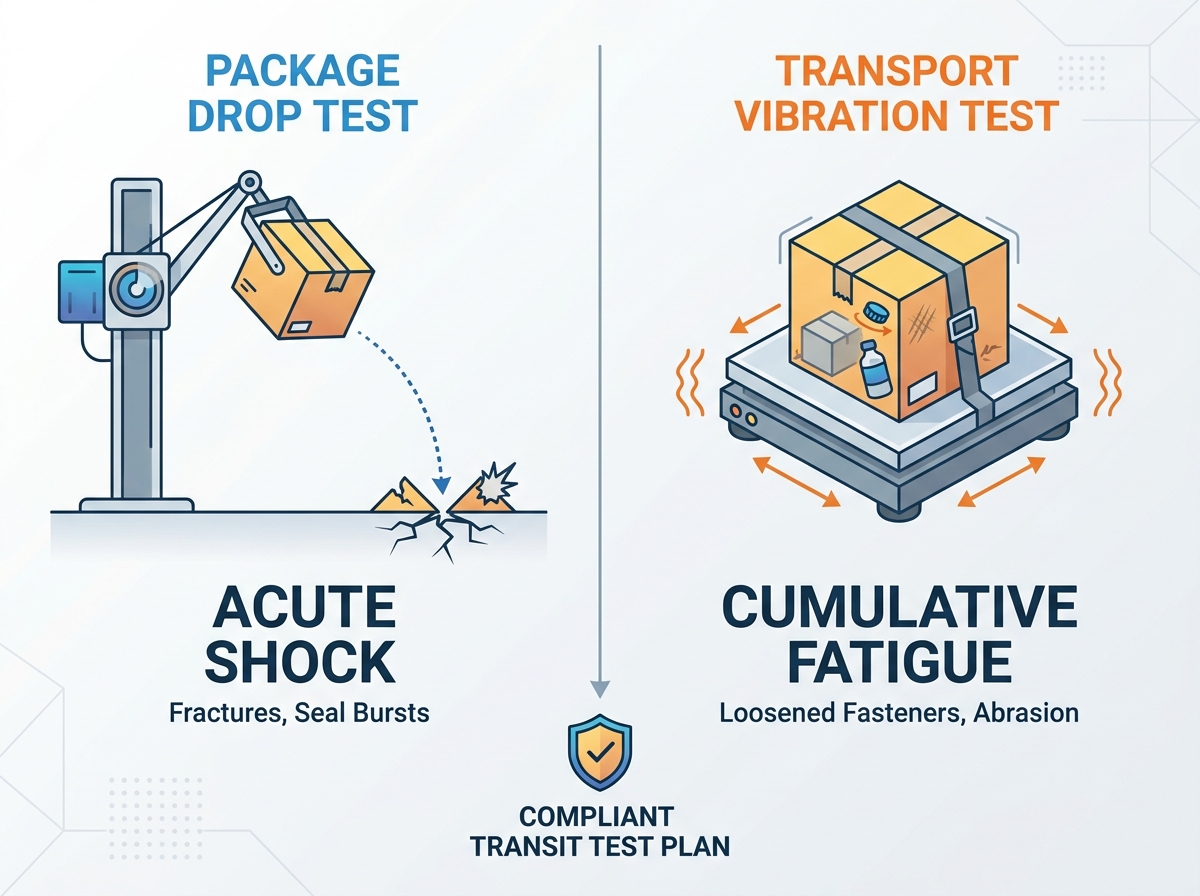
Understanding the exact mechanics behind each test type is crucial. They evaluate completely different failure dimensions.
The primary purpose of this method is direct impact simulation. It simulates free-fall drops to evaluate structural integrity. We test corners, edges, and flat faces systematically. This exposes how a box reacts when gravity takes over abruptly.
Deploying the right equipment guarantees testing accuracy. The single arm drop tester serves as an industry standard here. It achieves highly repeatable, precision-oriented drops. Its design eliminates rotational interference during the fall. The package hits the impact surface exactly as intended.
Acute shock tests reveal highly specific, catastrophic identifiable failures. You will typically see shattered internal components. You might also find breached sterile medical barriers. Compromised primary containment is another common result. Identifying these flaws early prevents disastrous customer unboxing experiences.
While drops simulate sudden impacts, vibration simulates a grueling journey. The purpose here is to replicate the continuous dynamic loads of a moving vehicle. We use it to test for resonance and material fatigue over hours of simulated travel.
Lab setups rely on specialized, heavy-duty equipment. We use mechanical fixed-displacement tables or advanced servo-hydraulic random vibration tables. Both are essential for rigorous transport vibration testing. Servo-hydraulic systems are especially precise. They recreate the exact, erratic bounce patterns of highway trucks.
The identifiable failures from continuous shaking differ greatly from impact damage. You will commonly discover severely scuffed labels. Unthreaded caps on liquid containers are another frequent issue. You may notice the extreme settling of granular products. The slow breakdown of corrugated fluting is also a major concern. These issues degrade product presentation and functionality.
Testing Modality Comparison Matrix
Evaluation Dimension | Drop Testing | Vibration Testing |
|---|---|---|
Hazard Simulated | Manual handling, falls, sorting chutes | Vehicle transit, resonance, dynamic loads |
Failure Mechanism | Acute shock and rapid deceleration | Cumulative material fatigue over time |
Common Damage | Fractures, container bursting, denting | Abrasion, unthreading, structural settling |
Primary Equipment | Free-fall machines, swing-arm systems | Mechanical or servo-hydraulic tables |
Industry authorities provide strict frameworks to ensure testing consistency. You cannot simply drop a box a few times and call it secure. We must look to organizations like ISTA and ASTM to structure our test protocols correctly.
Framework alignment is the first step toward global compliance. ISTA Series 1 focuses on basic integrity testing. It checks if the package can survive a very minimal set of hazards. ISTA Series 3 offers general simulation. It uses advanced profiles to replicate actual transport environments accurately. ASTM D4169 provides a similarly rigorous, globally recognized framework.
Following the sequence rule is vital for accurate simulation. These standards rarely isolate hazards. They mandate a specific compliance sequence. Typically, protocols require vibration testing first. This simulates the long transit journey. Then, they require drop testing. This simulates final manual handling at the destination. Sometimes, standards demand drops both before and after vibration. This captures the full reality of modern logistics.
Adhering to these standards provides incredible evidentiary value. Verifiable data protects your business. When carriers deny damage claims, certified test reports prove your packaging was sound. Furthermore, these tests validate new sustainable packaging materials. You can prove eco-friendly alternatives perform just as well as traditional plastics.
Once you understand the requirements, you must decide how to execute them. Building an internal lab presents distinct advantages and challenges compared to outsourcing.
Bringing testing equipment in-house transforms your product development cycle. Scalability and volume are the primary drivers for this decision. If your team tests new SKUs daily or weekly, capital expenditure makes sense. Owning the equipment accelerates your speed to market drastically.
However, you must evaluate serious space and facility risks. Real-world physical considerations matter. You need adequate ceiling height to accommodate drop machinery safely. Vibration tables require substantial floor reinforcement. They also generate severe noise, necessitating dedicated isolation rooms.
You also face ongoing calibration and maintenance requirements. Keeping testing machinery compliant with ISO and ASTM standards is not free. These hidden operational costs add up. You must schedule routine calibrations, replace worn mechanical parts, and train dedicated lab personnel.
Sometimes, building an internal facility simply isn't practical. The outsourcing alternative offers an immediate, flexible solution for many brands.
Knowing when to outsource preserves your budget. It is ideal for low-volume testing schedules. If you only launch two products a year, third-party labs are highly efficient. Outsourcing is also mandatory when specific environments are needed. Highly specialized environmental conditioning—like freezing temperatures paired with high humidity—is expensive to simulate internally. Finally, major retailers often mandate independent, third-party certification. In these cases, outsourcing is not just an option; it is a strict requirement.
You now understand the hazards, the equipment, and the implementation strategies. The next phase is building your specific test plan. You must tailor this plan to your unique products.
Start with a thorough risk assessment. You must evaluate product fragility against your specific distribution severity. Shipping heavy industrial parts via LTL freight carries different risks than shipping delicate cosmetics via parcel delivery. You need to map these variables.
Apply clear prioritization logic if budgets are tight. If initial capabilities are strictly limited, let historical damage data guide you. You must decide which test to run based on actual return metrics. Prioritize impact assessments for heavy, rigid items that easily break their outer cartons. Conversely, prioritize continuous motion tests for liquid containers, complex electronics, or easily scuffed premium goods.
Execute these next-step actions to formalize your strategy:
Audit current damage reports and return merchandise authorization (RMA) data to identify failure trends.
Identify the target ISTA or ASTM standard based directly on your primary carrier requirements.
Request equipment spec sheets or specialized lab quotes based on the heaviest and largest anticipated package payload.
Securing your supply chain requires a comprehensive testing approach. The debate surrounding different testing methods is ultimately solved by strategic integration, not elimination. You need both impact and motion data to protect your products fully.
A balanced transit test plan yields a direct return on investment. It systematically lowers your damage rates. It also helps you optimize your material spend by preventing wasteful over-packaging. You save money on both ends of the distribution cycle.
Take action today by reviewing your current shipping data. Audit your recent transit damage reports carefully. Review new equipment specifications or consult with external lab services. Closing your compliance gaps now will safeguard your brand reputation for years to come.
A: Sequence depends on the specific standard, like the ASTM D4169 schedule. Typically, vibration is performed first to simulate the long transportation journey. Drops follow to simulate the rough final handling at the destination. However, some stringent protocols require impact tests both before and after the continuous motion phase.
A: Capacity varies significantly by manufacturer. Most standard single-arm machines are engineered for parcel-sized loads up to 150–200 lbs. If your packages exceed this weight, you will require heavy-duty dual-arm machines or quick-release platen systems to perform the test safely.
A: No. They evaluate entirely different physical failure mechanisms. Motion tables expose cumulative material fatigue and resonance. Impact tests evaluate acute shock and rapid deceleration. One cannot substitute for the other if you want a certified, reliable transit test plan.


