
close
Choose Your Site
Global
Social Media

Views: 0 Author: Site Editor Publish Time: 2026-09-09 Origin: Site


Selecting the right thermal testing or processing equipment requires balancing upfront capability against strict compliance and production requirements. Equipment engineers often face a challenging procurement decision. Both systems apply controlled thermal energy to a product. However, their primary mechanisms differ significantly. The choice dictates whether a facility can merely heat-process components or fully simulate harsh environmental conditions for lifecycle testing. Making the wrong choice leads to wasted resources, production bottlenecks, or failed compliance audits.
We will explore how these distinct systems operate at a mechanical level. You will learn how to map specific equipment features to your operational goals. We will also cover long-term maintenance requirements and implementation risks. This knowledge ensures you specify the correct equipment for your facility.
Primary Function: Industrial ovens are engineered for heat-only applications (drying, curing, baking), whereas climate test chambers simulate complete environmental stress (heating, cooling, and moisture).
Cost & Complexity: Adding humidity and refrigeration systems significantly increases a chamber's initial capital expenditure and ongoing maintenance compared to an oven.
Compliance Needs: Climate test chambers are mandatory for strict reliability standards (e.g., MIL-STD, IEC, ASTM), while ovens typically serve manufacturing and basic thermal aging.
Infrastructure: Chambers require specialized facility utilities (demineralized water, drainage, higher amperage for compressors) that ovens do not.
Understanding the mechanical differences helps clarify why these units serve distinct purposes. They rely on completely different engineering principles to achieve thermal control.
An industrial oven operates on relatively straightforward principles. It primarily relies on durable heating elements and powerful convection blowers. The blowers circulate hot air aggressively around the workspace. This constant circulation ensures uniform temperature distribution across all test subjects or products.
These units only provide ambient cooling. They cool the workspace by exhausting hot air and drawing in room-temperature air from the lab environment. They cannot cool products below ambient lab temperatures. If your lab sits at 22°C, the oven cannot drop the internal temperature to 15°C.
Moisture control does not exist in these systems. Any moisture present inside the workspace is strictly a byproduct of the test subject itself. As products heat up, they may release water vapor. The oven exhausts this stray vapor through adjustable dampers. The system never actively injects or regulates humidity.
Chambers operate using highly complex, interacting subsystems. They integrate closed-loop refrigeration systems powered by heavy-duty compressors. This allows them to perform rapid thermal cycling and achieve extreme sub-zero testing temperatures. Many chambers utilize cascade refrigeration to push temperatures down to -70°C.
Moisture regulation is a defining feature. These chambers utilize electric vapor generators or fine atomizers to precisely inject moisture into the airstream. They also employ dedicated dehumidification coils. These cold coils pull moisture out of the air through condensation.
Managing these variables requires advanced control logic. They feature sophisticated PID (Proportional-Integral-Derivative) controllers. The controllers constantly manage the complex psychrometric relationship between temperature and relative humidity (RH). If the temperature drops, the RH naturally spikes. The controller must rapidly engage dehumidification to maintain the requested setpoint. This active balancing act separates a chamber from a basic heating unit.
Certain facility goals heavily favor heat-only systems. You should specify an industrial laboratory oven when you prioritize high-throughput manufacturing, low-complexity thermal processing, and basic materials testing.
Ovens excel in production environments. We frequently see them used for several core applications:
Curing materials: They rapidly cure specialized coatings, heavy-duty epoxies, and polyimides. The constant convection speeds up chemical cross-linking.
Drying and sterilizing: They excel at drying raw bulk materials or sterilizing medical equipment before packaging.
Annealing components: Manufacturers use them for annealing plastics or metals. Controlled heating and slow cooling relieve internal mechanical stresses inside the material.
Simplicity delivers distinct operational benefits. Minimal mechanical complexity directly translates to high equipment uptime. Your maintenance overhead drops significantly because you do not maintain compressors or water lines.
You also gain spatial efficiency. Ovens offer much larger internal testing capacities at a significantly lower price point. You get more usable cubic volume for every dollar spent. This proves critical for bulk manufacturing processes.
You must acknowledge their operational limits. They cannot induce cold-weather stress on a product. They cannot perform sudden freeze-thaw cycles. Furthermore, you cannot use them to verify product seals against active moisture ingress. If your test profile requires these elements, an oven will fail to deliver.
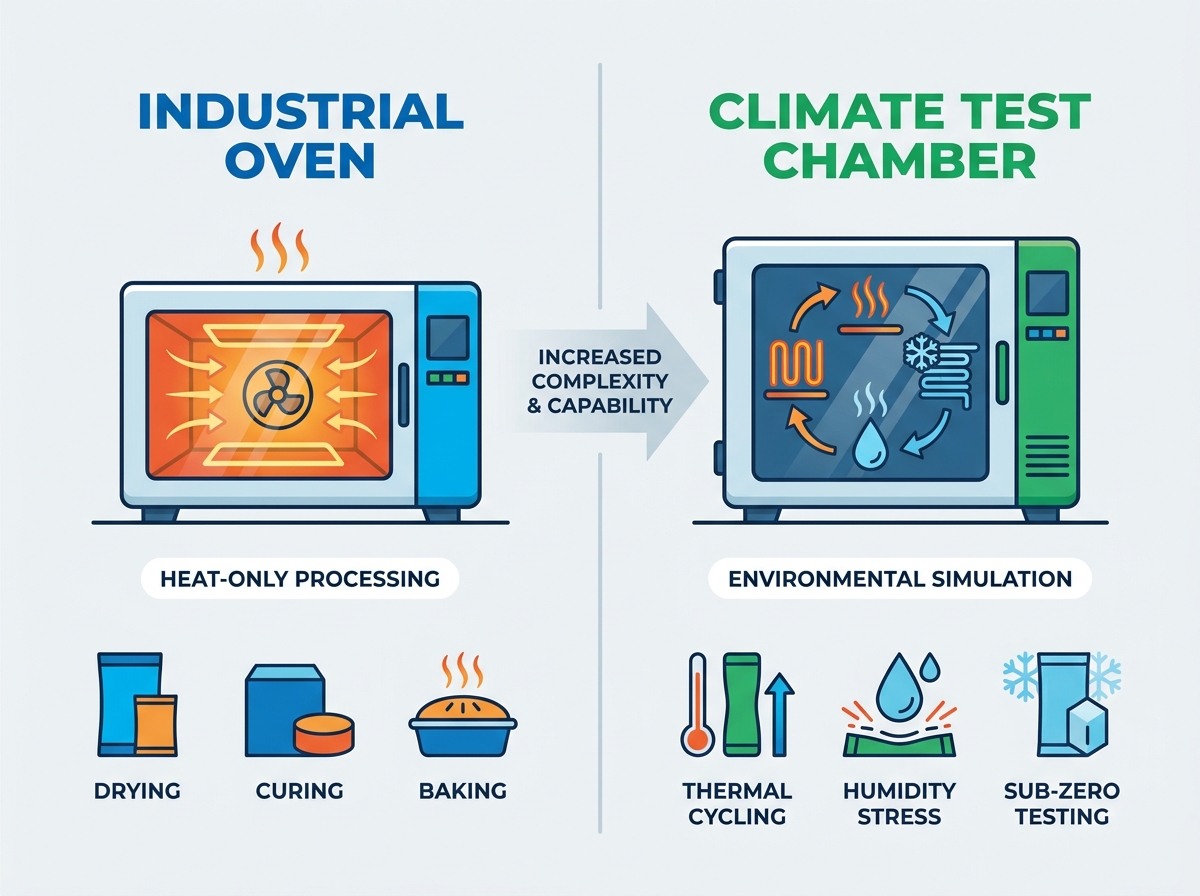
You specify a climate test chamber when your ultimate business outcomes focus on proof of reliability, aggressive warranty reduction, and passing stringent industry compliance audits. These units exist to break products under controlled conditions.
Chambers handle complex validation profiles. They are the backbone of modern reliability engineering. Key applications include:
Accelerated lifecycle testing: Engineers use them for HALT (Highly Accelerated Life Test) and HASS (Highly Accelerated Stress Screen). These tests quickly force product failures to reveal design flaws.
Battery thermal runaway testing: Testing lithium-ion cells requires precise ambient control. These chambers often feature specific safety modifications, including blast relief ports and gas detection systems.
Electronic component validation: They verify vulnerable solder joints under intense thermal shock and sustained moisture.
A chamber unlocks full compliance with global environmental testing standards. Military, automotive, and aerospace sectors require strict adherence to profiles like MIL-STD-810 or IEC 60068. Only a true chamber can execute these profiles accurately.
Furthermore, it identifies latent design defects long before market release. It reveals damage caused by rapid moisture expansion or aggressive thermal contraction. Catching these defects early prevents catastrophic field failures.
These advanced capabilities require specific facility accommodations. The footprint often demands more floor space simply to house the bulky refrigeration racks. Additionally, it requires strict water quality management for the humidity system. Ignoring these limitations leads to frequent breakdowns.
Making a confident choice requires analyzing your facility infrastructure alongside your testing goals. We must evaluate three major logistical pillars.
You must carefully assess whether a heat-only process fulfills the immediate need. Over-specifying a temperature humidity chamber vs industrial oven when only heating is required drains capital. Do not buy a complex refrigeration system if you only bake circuit boards. Map your current profiles strictly to equipment capabilities.
Infrastructure dictates equipment viability. You cannot simply plug a chamber into a standard wall outlet and start testing.
Water Quality: Chambers require RO/DI (Reverse Osmosis/Deionized) water. Normal tap water contains minerals. These minerals quickly build up on sensitive humidity sensors and internal heaters. This scaling destroys equipment.
HVAC Considerations: Chambers generate significant rejected heat from their heavy compressors. You must evaluate if the lab requires a water-cooled condenser hookup or if the building HVAC can handle massive air-cooled exhaust.
Evaluate if your testing protocol requires specific thermal transition rates. For example, some standards demand a strict 5°C per minute change. Ovens possess slower, highly imprecise cooling rates. Chambers, however, provide highly controlled, linear ramp rates in both heating and cooling directions.
Table 1: Equipment Selection Criteria Summary
Evaluation Feature | Industrial Oven | Climate Chamber |
|---|---|---|
Temperature Range | Ambient to very high heat | Deep sub-zero to high heat |
Humidity Control | None (Exhaust only) | Precise active control (10% to 98% RH) |
Cooling Mechanism | Ambient air exchange | Mechanical cascade refrigeration |
Infrastructure Load | Low (Standard electricity, ventilation) | High (RO/DI water, heavy amperage, drains) |
Long-term operational planning prevents unexpected downtime. You must account for the specialized maintenance required by complex thermal systems.
Ovens generally demand minimal intervention. Routine maintenance usually involves basic temperature calibration, visual element checks, and simple blower lubrication. Most in-house facility teams handle this easily.
Chambers demand highly specialized care. They require EPA-certified refrigeration technicians for routine compressor maintenance and refrigerant leak checks. Furthermore, you must regularly replace sensitive wet-bulb/dry-bulb sensors or calibrate capacitive humidity sensors.
Both systems feature durable industrial construction. They can comfortably last 15 or more years. However, a climate test chamber inherently requires much higher ongoing maintenance effort to sustain that lifespan. Moving parts fail without rigorous preventive schedules.
Use a strict audit logic to guide your final choice. Audit your current and projected 5-year testing standards. If no anticipated standard mandates cooling or humidity, you should confidently default to an industrial oven.
However, apply the 10% rule. If you require moisture control or sub-ambient temperatures even 10% of the time, a climate test chamber remains the only compliant path forward. Outsourcing that 10% to a third-party lab often disrupts production schedules.
The choice hinges directly on whether your product needs straightforward thermal processing or rigorous environmental validation. Ovens deliver unmatched efficiency for baking, drying, and curing applications. Chambers remain indispensable for inducing real-world environmental stress, proving reliability, and meeting strict global compliance standards.
Your next steps should involve direct collaboration with equipment engineers. You must review your specific test profiles together. Clearly define your required temperature ranges, necessary RH percentages, and expected live loads. Use this data to size the equipment accurately before requesting comparative quotes. Proper upfront sizing eliminates unexpected performance bottlenecks.
A: No. While some ovens can exhaust moisture released by the product, they do not have active steam generation or dehumidification capabilities to maintain a specific RH setpoint.
A: Yes, chambers can run in heat-only modes. However, using a high-cost chamber exclusively for drying is an inefficient use of testing assets and introduces unnecessary wear on the system.
A: Tap water contains minerals that will scale and permanently damage the internal heaters, atomizers, and precision sensors over time, voiding warranties and compromising test accuracy.
A: Depending on what is being heated (e.g., solvents, volatile organic compounds), the oven may require specialized exhaust routing or explosion-proof (Class A) ratings.


