
close
Choose Your Site
Global
Social Media

Views: 0 Author: Site Editor Publish Time: 2026-06-13 Origin: Site


Unpredictable thermal behavior in polymers leads to catastrophic end-use failures, costly material recalls, and rejected production batches. It forces engineering teams into reactive crisis management. Relying on generic datasheet values for material heat resistance is a high-risk strategy. Variations in compounding, molding stresses, and polymer blending require localized, verifiable thermal deformation data. You cannot trust baseline numbers when real-world variables intervene.
Investing in a precise, standard-compliant testing apparatus transforms heat resistance evaluation. It shifts the process from a theoretical baseline into a verifiable quality control metric. This data directly informs material selection, compliance, and product safety. By reading this guide, you will learn how to evaluate testing methodologies. You will discover how to assess equipment capabilities properly. Finally, you will understand how to implement robust testing protocols for your laboratory.
Thermal deformation data dictates polymer selection for high-stress, high-temperature applications; precision testing mitigates the risk of structural failure.
The distinction between Heat Deflection Temperature (HDT) and Vicat Softening Temperature requires equipment capable of supporting dual, distinct load and penetration metrics.
Evaluating a new apparatus requires focusing on heating rate stability, sensor resolution, and strict adherence to global standards (ISO and ASTM).
Imprecise testing data carries severe commercial consequences. A variance of even 2–3°C during thermal testing leads directly to inappropriate polymer selection. For example, an automotive engineer might specify standard ABS based on flawed test results. However, dashboard components exposed to direct sunlight actually require high-heat ABS or a robust PC/ABS blend. When the standard polymer warps under summer heat, the manufacturer faces massive recall campaigns and brand damage.
Standardization serves as a fundamental business requirement. OEMs and global regulatory bodies now mandate verifiable thermal profiles before approving any component. Missing compliance thresholds for ISO or ASTM standards immediately disqualifies material suppliers from lucrative contracts. You must provide reliable, repeatable data to remain competitive.
A highly accurate thermal deformation test machine bridges the critical gap between R&D and QA departments. It standardizes data sets across your entire organization. This alignment ensures R&D formulations match production-floor realities perfectly. When both teams rely on the same calibrated data, material scaling becomes predictable and safe.
You must understand the fundamental differences between testing protocols to establish a reliable QA framework. Modern laboratories need equipment capable of managing distinct testing physics. Each protocol serves a specific engineering purpose.
HDT measures macro-deformation under a specific flexural stress. Laboratories typically apply 0.45 MPa or 1.8 MPa loads to a molded bar. This test determines the structural load-bearing capacity of a polymer at elevated temperatures. To achieve accurate results, you need a dedicated heat deflection temperature apparatus. The equipment must feature high-rigidity loading frames. Rigid frames prevent mechanical bias from skewing the deflection data.
The Vicat protocol measures localized surface softening. It utilizes a flat-ended needle featuring a precise 1 mm² cross-section. The test applies distinct loads of either 10N or 50N. This method is ideal for understanding thermal processing limits and identifying surface degradation points. It requires a highly calibrated Vicat softening point tester equipped with micrometer-level penetration sensors.
Modern testing workflows demand high efficiency. Your polymer heat resistance equipment must handle both protocols seamlessly. Dual-capability machines provide a complete thermal profile without duplicating your laboratory footprint. Interchangeable testing heads allow operators to switch between HDT edges and Vicat needles quickly.
Parameter | HDT Protocol | Vicat Protocol |
|---|---|---|
Measurement Type | Macro-deformation (Flexural) | Localized surface softening |
Indenter Shape | Loading edge (3-point bending) | Flat-ended needle (1 mm²) |
Standard Loads | 0.45 MPa or 1.8 MPa | 10N or 50N |
Primary Application | Structural load-bearing limits | Thermal processing limits |
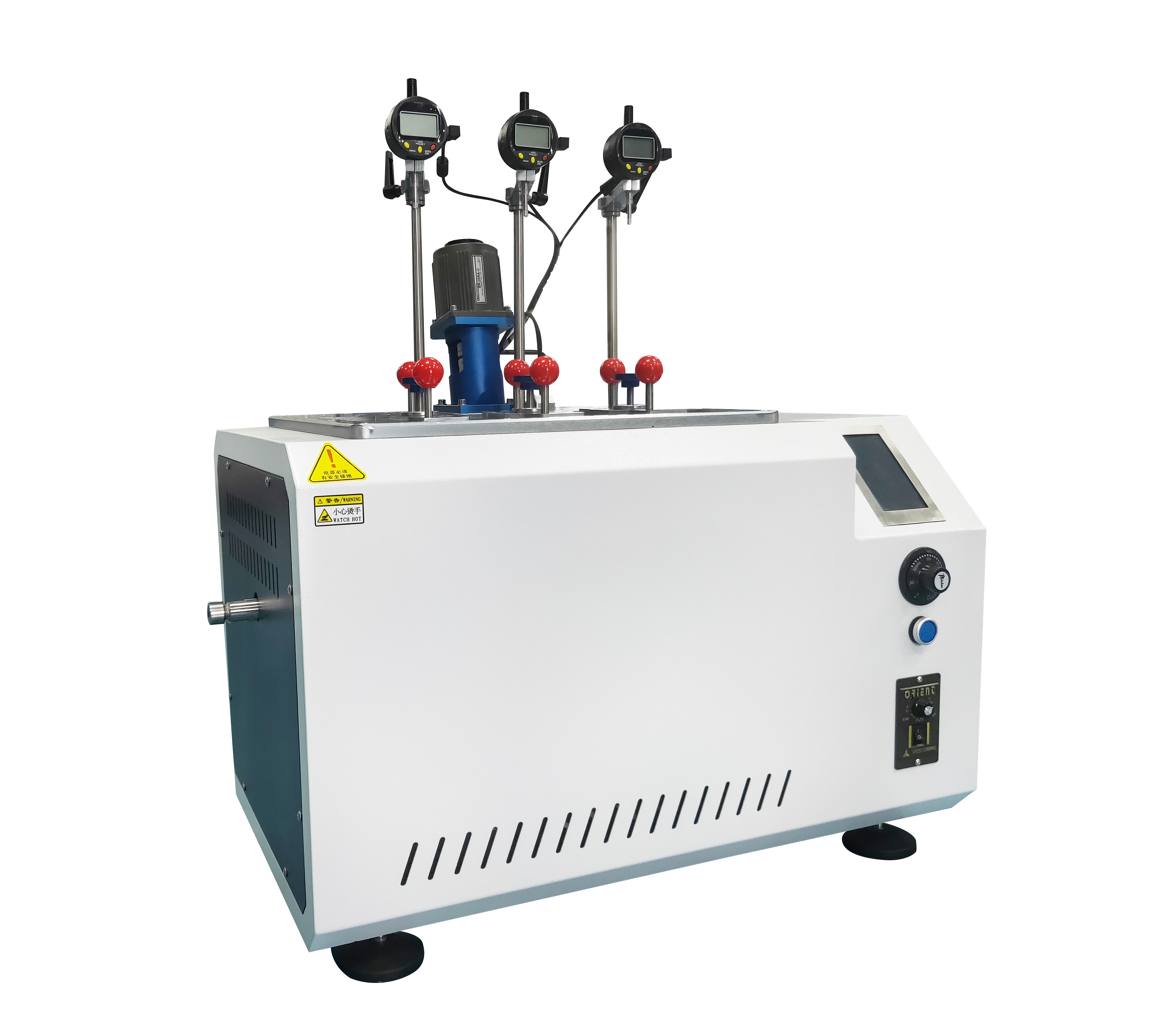
Evaluating new equipment requires strict attention to mechanical and thermal precision. You must look beyond basic specifications to understand how the machine performs under daily stress.
Uniform temperature ramping is critical for valid tests. Standards typically require heating rates of 50°C/hr or 120°C/hr. Unstable PID controllers cause severe thermal gradients in the bath. These sudden temperature spikes shock the polymer sample. Thermal shock invalidates the test data entirely. Always verify the stability of the heating control algorithms.
Linear variable differential transformer (LVDT) sensors measure the actual deformation. You must demand sensor resolutions of at least 0.001 mm. High-resolution sensors capture exact deformation points without mechanical hysteresis. Poor sensors lag behind the actual material movement, resulting in artificially inflated temperature readings.
The physical design must inherently satisfy global testing standards. A compliant HDT Vicat test apparatus meets ISO 75 and ASTM D648 for HDT. It also satisfies ISO 306 and ASTM D1525 for Vicat. Certified calibration weights represent a non-negotiable feature. Uncalibrated weights apply incorrect stress, rendering the entire procedure useless.
The mechanics of the stirrer dictate the uniformity of the heat transfer fluid. Laboratories usually utilize specialized silicone oil. Poor circulation within the bath creates localized hot spots. These hot spots lead to premature sample deformation. A robust stirring mechanism ensures thermal equilibrium across all testing stations simultaneously.
Best Practice: Always verify oil circulation patterns during your equipment demonstration.
Best Practice: Request a third-party calibration certificate for the LVDT sensors before finalizing procurement.
Modern testing environments cannot afford manual inconsistencies. Automation protects your data integrity while dramatically increasing your daily sample throughput.
Mitigating operator variance remains a primary goal. Transitioning from manual weight application to automated systems solves this problem. Pneumatic or motorized load-lowering mechanisms prevent accidental impact damage to the sample. They ensure a perfectly repeatable initial contact point every single time. Dropping a weight manually introduces micro-cracks into soft plastics.
Software and connectivity separate basic machines from enterprise solutions. Look for systems capable of plotting real-time temperature versus displacement curves. Automated calculation of test results eliminates human mathematical errors. Exportable audit trails in CSV or PDF formats guarantee traceability. Furthermore, direct integration into your Laboratory Information Management System (LIMS) streamlines data storage and compliance reporting.
Cooling efficiency often becomes the primary throughput bottleneck. An HDT Vicat tester spends significant time cooling down between high-temperature test runs. You must evaluate cooling infrastructure carefully. Integrated tap water cooling works for low-volume labs. However, high-volume environments require dedicated external chiller units. Chillers drop the oil temperature rapidly, doubling your actual daily test capabilities.
Integrating high-temperature fluid baths into a laboratory introduces specific operational challenges. You must prepare your facility and train your operators to handle these realities.
Operating oil-bath testers involves messy realities. Silicone oil degrades over time. It darkens and loses its optimal thermal transfer properties. At high temperatures, the oil emits noticeable fumes. You should evaluate equipment based on its built-in vapor exhaust systems. Adequate oil capacity and smart drainage designs make mandatory fluid replacements much safer and faster.
Constant thermal cycling degrades mechanical components. Mechanical wear on Vicat indenters alters the surface area geometry. Thermal fatigue on LVDT sensors introduces calibration drift over time. You must enforce strict, scheduled calibration regimens. Assess your vendor's service agreements carefully. Ensure they provide rapid access to certified standard reference materials for internal verification.
Testing environments reaching up to 300°C present severe burn hazards. Operator safety is paramount. Mandatory safety features must include fully enclosed testing stations. Automatic over-temperature shutoffs prevent catastrophic thermal runaway. Secure, automated sample retrieval mechanisms keep operator hands away from boiling silicone oil.
Failing to replace silicone oil until it turns completely black, which skews thermal transfer rates.
Relying solely on factory calibration without scheduling annual third-party metrology audits.
Ignoring proper fume extraction, leading to poor laboratory air quality and operator discomfort.
Procuring thermal testing equipment requires a structured evaluation process. Follow these specific steps to match the apparatus to your laboratory requirements.
Step 1: Define volume and material types. High-throughput labs require multi-station systems ranging from 3 to 6 test stations. If you test high-performance engineering plastics like PEEK, you need systems capable of reaching 300°C or higher.
Step 2: Assess cooling infrastructure. Match the apparatus to your lab's existing capabilities. Determine if standard plumbing can handle the cooling load. If not, you must procure a dedicated recirculating chiller to maintain test volume.
Step 3: Conduct vendor evaluation. Demand verifiable industry case studies. Review sample calibration certificates thoroughly. Request a live software demonstration to assess user interface logic, data export capabilities, and LIMS compatibility.
Actionable Next Step: Compile a comprehensive matrix. Document your expected daily testing frequencies. List the maximum temperature requirements for your toughest polymers. Use this exact matrix when initiating your Requests for Quote (RFQs).
Thermal deformation data remains a non-negotiable metric for high-stakes polymer selection. Relying on generic assumptions guarantees product failure in the field. Selecting the right testing apparatus requires balancing several crucial factors. You must weigh sensor precision, mechanical automation, and cooling efficiency against your actual daily throughput needs. An automated, dual-capability system protects your brand by ensuring absolute compliance with global standards. We highly encourage laboratory managers and procurement engineers to audit their current thermal testing procedures today. Reach out to qualified manufacturers, request a technical consultation, and schedule an equipment demo to see these metrics in action.
A: Standard models typically range up to 300°C using specialized silicone oil as the heat transfer medium. Specialized high-temperature versions utilize aluminum oxide powder beds or advanced synthetic fluids. These specialized models can reach up to 400°C or 500°C to test advanced engineering polymers safely.
A: Yes. Most modern thermal deformation test machines accommodate both testing protocols. They feature interchangeable testing heads. Operators easily swap indenter needles for Vicat tests and loading edges for HDT tests. Configurable weight sets allow you to support both protocols in the exact same thermal bath.
A: Industry best practice dictates strict annual calibration. ISO and ASTM compliance standards require you to calibrate temperature sensors, displacement transducers (LVDTs), and application weights once a year. An accredited third-party metrology service must perform this calibration to ensure absolute data validity.
A: The test bath must cool back down to ambient or a specific starting temperature before you can begin a new test. Slow, natural cooling severely limits your daily laboratory throughput. Integrated water cooling or external chiller systems represent crucial operational features to maximize test volume.


