

close
Choose Your Site
Global
Social Media

Views: 0 Author: Site Editor Publish Time: 2026-06-10 Origin: Site


Increasing regulatory scrutiny on fire hazards in consumer electronics demands precise, verifiable flammability testing. Global safety watchdogs ruthlessly penalize hardware failures today. Proactive safety validation represents an absolute business necessity. A certified glow wire test apparatus effectively bridges the gap between prototype material selection and final IEC compliance validation.
Unverified insulating materials in live R&D prototypes introduce massive risks. You need reliable tools to prevent catastrophic compliance failures late in the product lifecycle. This guide provides quality assurance and laboratory managers an evidence-based framework for facility upgrades. We help you evaluate, specify, and implement strictly compliant IEC 60695-2-10 equipment.
You will discover how to navigate core hardware specifications and master critical measurement metrics. We will explore the vital differences between manual and computer-controlled systems. You can leverage these insights to optimize testing workflows and secure an unassailable audit trail for your organization.
Compliance Baseline: A strictly compliant glow wire test apparatus must adhere to IEC 60695-2-10 specifications, specifically regarding the 4mm Ni/Cr wire loop, 1.0N applied force, and Class 1 thermocouple accuracy.
Testing Metrics: Evaluating equipment requires understanding its ability to accurately log both Glow Wire Flammability Index (GWFI) and Glow Wire Ignition Temperature (GWIT).
Automation vs. Manual: Transitioning to a computer-controlled fire hazard testing machine reduces operator variance, ensures repeatable contact times, and automates compliance reporting.
Outsourcing material flammability testing introduces massive lead-time bottlenecks during the R&D iteration phase. You ship physical prototypes to external laboratories. You wait weeks for basic material qualification results. This delay stalls product development and frustrates engineering teams. When a material fails a third-party test, your team must formulate a new blend and restart the agonizing waiting period. Internalizing this capability restores momentum to your engineering cycle.
Unverified insulating materials present severe dangers. Live current-carrying R&D prototypes often operate under extreme stress. Unqualified plastics risk catastrophic compliance failures late in the product lifecycle. A late-stage failure requires expensive redesigns. It delays product launches and damages brand reputation. Integrating an electrical safety test apparatus directly into your facility mitigates these late-stage disasters. Engineers can screen materials before finalizing injection molding tools.
Bringing testing in-house delivers immediate returns. Internalized IEC 60695 test equipment accelerates material qualification significantly. Appliance manufacturing standards demand rigorous validation. Having equipment on-site allows engineers to run dozens of iterative tests daily. Furthermore, modern setups secure an unassailable audit trail for regulatory bodies. You generate standardized reports internally. You prove continuous compliance effortlessly. This operational independence transforms your laboratory into a strategic asset.
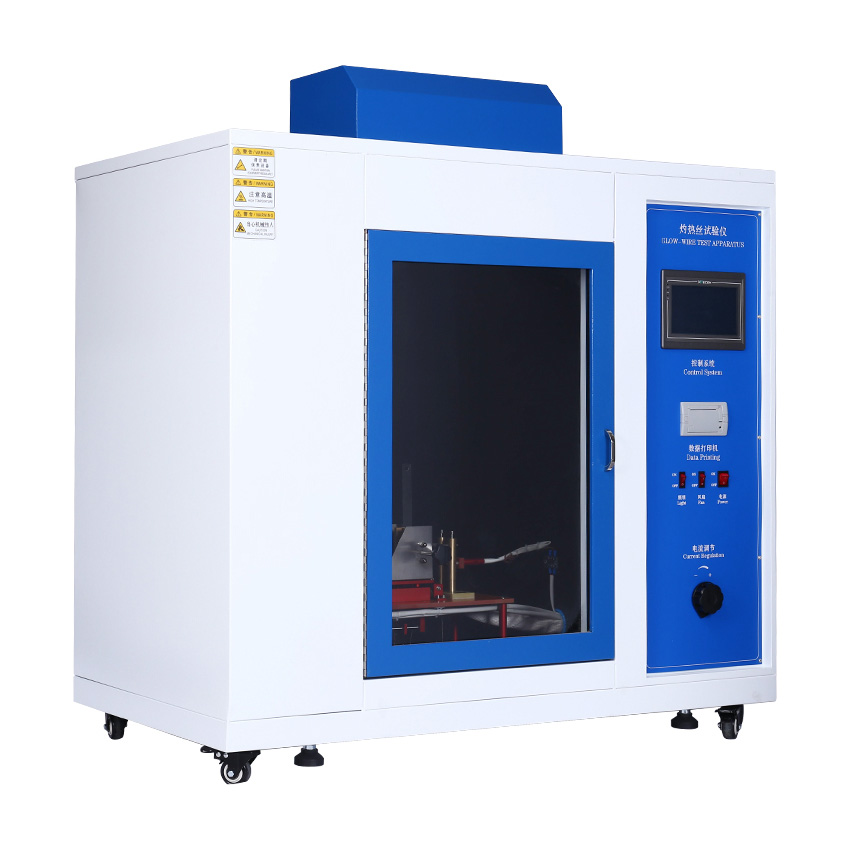
Compliance begins with uncompromising hardware. The IEC 60695-2-10 standard dictates non-negotiable physical requirements for the testing chamber. We must examine the core mechanism carefully. Every component must meet strict dimensional and performance tolerances.
The heat source relies on a very specific element. You must use a 4 mm diameter Nickel/Chromium (80/20) wire loop. This specific alloy ratio guarantees thermal stability at extreme temperatures. It resists oxidation during prolonged testing. The loop must maintain its exact shape to ensure uniform contact with the specimen. Even minor deformations invalidate your test results.
Temperature measurement requires extreme precision. The standard mandates a 0.5 mm Type K (NiCr-NiAl) sheathed fine-wire thermocouple. Manufacturers must embed this sensor precisely in the wire tip. This placement captures the exact temperature at the point of contact. Any deviation in thermocouple placement causes catastrophic measurement errors. The mechanical carriage also faces strict regulations. Systems must deliver exactly 1.0 N ± 0.2 N of force upon sample contact. A mechanical stop must physically limit wire penetration to exactly 7 mm.
Wire Composition: 80% Nickel, 20% Chromium
Wire Diameter: 4.0 mm precise thickness
Thermocouple Type: Type K (NiCr-NiAl), 0.5 mm sheath
Application Force: 1.0 N (± 0.2 N tolerance)
Penetration Depth: Maximum 7.0 mm mechanical limit
Equipment accuracy degrades over time. You cannot trust unverified temperature displays. The standard demands a silver foil melting point test. You place a piece of 99.8% pure silver foil on the wire tip. Pure silver melts at exactly 960°C. You slowly increase the wire temperature. The foil must melt the moment the system registers 960°C. This physical validation guarantees instrument accuracy. You must perform this verification regularly to maintain compliance integrity.
Component | IEC 60695-2-10 Requirement | Critical Function |
|---|---|---|
Heating Element | 4mm Ni/Cr (80/20) Loop | Delivers stable, localized thermal stress. |
Temperature Sensor | 0.5mm Type K Thermocouple | Measures exact contact point temperature. |
Mechanical Carriage | 1.0 N ± 0.2 N Force | Ensures consistent pressure on the sample. |
Penetration Stop | 7 mm Limit | Prevents the wire from piercing the sample entirely. |
Calibration Target | 99.8% Pure Silver Foil | Validates system accuracy at 960°C. |
Evaluating plastic materials requires two distinct metrics. You must understand how your apparatus measures the Glow Wire Flammability Index (GWFI) and the Glow Wire Ignition Temperature (GWIT). These metrics align specific hardware features with testing outcomes. Proper alignment ensures accurate material classification.
The Glow Wire Flammability Index (GWFI) evaluates self-extinguishment. It measures how a material behaves after the heat source retracts. The machine tests the material at standardized intervals. Common intervals include 650°C, 750°C, and 850°C. The wire presses into the sample for 30 seconds. The carriage then pulls the wire away. You must document if the flame extinguishes within 30 seconds of wire removal. The material passes if it stops burning quickly and does not ignite the tissue paper below.
The Glow Wire Ignition Temperature (GWIT) assesses ignition resistance. It determines the exact thermal threshold where a material ignites. The testing protocol requires extreme precision. We look for the highest temperature where continuous ignition does not occur for more than 5 seconds. You find this baseline, then add 25K (or 30K for specific materials) to determine the final GWIT rating. A highly sensitive glow wire flammability tester proves essential here. Even minor temperature fluctuations ruin the GWIT assessment.
Accurate evaluation demands synchronized data capture. Operator reaction times introduce unacceptable variables. Follow these critical steps during evaluation:
Stabilize the chamber environment to ensure zero drafts.
Heat the wire to the target temperature and allow stabilization.
Engage the automated carriage to apply exactly 1.0N of force.
Start synchronized timers the moment the wire touches the specimen.
Record any ignition events visually using internal cameras or clear observation windows.
Retract the wire exactly at the 30-second mark.
Monitor the specimen for self-extinguishment and tissue paper ignition.
Visual recording capabilities within the chamber help tremendously. Modern systems feature integrated cameras. Video evidence eliminates arguments during compliance audits. It provides unquestionable proof of ignition duration and flame height.
Laboratory managers face a crucial equipment choice. You must decide between traditional manual systems and modern computer-controlled architectures. Each approach offers distinct advantages and unique operational challenges. Understanding these differences ensures you select the right glow wire ignition tester for your facility.
Manual systems appeal to budget-conscious teams. They feature a lower initial R&D footprint. Their straightforward mechanical design simplifies basic maintenance. However, manual systems carry significant risks. They rely heavily on operator reaction times. The standard demands a strict 30-second application window. An operator might pull the carriage back at 28 seconds or 32 seconds. This human variance compromises the test. Furthermore, manual data transcription often leads to clerical errors during reporting.
Computer-controlled systems eliminate human variance entirely. Automated motorized carriages ensure exactly 30s ± 0.1s contact time. The machine applies the wire without human delay. It retracts the wire instantly when the timer expires. This precision guarantees repeatable results across thousands of samples.
Data integrity improves drastically with automation. Computer systems provide real-time temperature graphing. They detect thermal stabilization automatically before initiating the test. Once the test concludes, the software generates tamper-proof PDF reports. These automated reports satisfy the strictest regulatory auditors. Scalability also becomes effortless. You can program custom test profiles for regional standard variations. For example, you can switch seamlessly between BS EN 60695-2-10 and IS 11000.2.1 parameters with a single click.
Feature Area | Manual Systems | Computer-Controlled Systems |
|---|---|---|
Contact Timing | Operator dependent (High variance) | Motorized precision (30s ± 0.1s) |
Data Recording | Manual logbooks and stopwatches | Real-time graphing & auto-logging |
Reporting | Transcribed manually into templates | Tamper-proof, auto-generated PDFs |
Standard Switching | Requires manual recalibration | Pre-programmed software profiles |
User Error Risk | High (Timing and force application) | Minimal (Fully automated execution) |
Procuring a fire hazard testing machine requires a structured evaluation framework. You cannot buy based on specifications alone. The surrounding environment and vendor support directly impact your testing success.
Dimensional and environmental fit dictate chamber design. The standard mandates a draught-free dark chamber. It must exceed a minimum 0.5m³ internal volume. This volume requirement guarantees adequate oxygen consumption during the test. A smaller chamber starves the flame of oxygen, yielding false passes. The chamber interior must be dark. Dark walls allow operators to spot faint ignition flames easily. Evaluate the physical footprint carefully to ensure it fits your laboratory layout.
Exhaust and safety integration require rigorous scrutiny. Burning plastics release toxic fumes. You need an integrated exhaust fan. However, you must evaluate how the fan operates. The fan cannot run during the live test phase. Active airflow disrupts the flame and cools the wire, invalidating the results. The system must seal during the 30-second contact, then automatically vent the chamber immediately afterward.
Vendor support dictates your long-term success. Demand ISO 17025 accredited calibration certificates upon delivery. Uncertified equipment holds zero weight during regulatory audits. You must also secure a reliable supply of specific consumables. Check vendor availability for standardized glow wires, pure silver foil, specific wrapping tissue paper, and untreated pine wood boards. Running out of compliant pine boards halts your entire testing operation.
Take decisive next-step actions before purchasing. Do not buy blindly. Request sample test runs from shortlisted vendors. Send them your actual materials. Ask them to record the test and send the automated reports. Furthermore, demand live software demonstrations. The user interface should feel intuitive to your technicians. If the software is clunky, your team will struggle to generate compliant reports.
Acquiring a certified testing apparatus is not just a procurement exercise. It represents the integration of a comprehensive compliance system into your R&D workflow. Internalizing this capability protects your product lifecycle from late-stage regulatory disasters.
Choosing between manual or automated systems defines your future operational efficiency. Testing volume, R&D iteration speed, and required audit trail strictness should dictate this decision. High-volume labs processing dozens of daily samples absolutely require automated carriages. Smaller teams might succeed with manual setups if they enforce strict operator training protocols.
We encourage stakeholders to map their specific material testing thresholds directly to the equipment specs. Appliance sector manufacturers must verify specific GWIT minimums before issuing a purchase order. Ensure the machine guarantees thermal stability at your required testing peaks. Take action today by requesting sample reports from prospective vendors. Validate their software capabilities, secure your consumable supply chains, and build a robust internal safety protocol.
A: The industry standard requires formal ISO 17025 calibration annually. However, diligent laboratories supplement this with internal verifications. You should perform the silver-foil melting point test (at exactly 960°C) before initiating any major new testing batches. This frequent internal validation ensures the thermocouple and wire loop have not degraded from previous toxic burns.
A: Yes. High-quality systems feature variable temperature controllers ranging from ambient up to 1000°C+. This flexibility allows exploratory testing on novel polymer blends. As long as the motorized carriage mechanism allows custom contact timing, engineers can push prototype materials beyond standard limits to discover absolute thermal failure points during early R&D.
A: The IEC standard mandates a minimum 0.5m³ internal volume to prevent oxygen depletion. If the chamber is too small, the fire consumes all oxygen and prematurely extinguishes, causing false passes. Additionally, the dark interior (less than 20 lux) is absolutely required for operators or cameras to accurately confirm faint ignitions and measure flame heights.
A: A glow wire test simulates a specific internal fault, such as an overheated resistor contacting a plastic housing. Conversely, the needle flame test (IEC 60695-11-5) simulates exposure to an external open flame. Because these represent entirely different real-world fire risks, comprehensive safety laboratories often require both testing machines to achieve full product certification.


