
close
Choose Your Site
Global
Social Media

Views: 0 Author: Site Editor Publish Time: 2026-03-23 Origin: Site


Ever wondered how manufacturers ensure plastic quality? The Melt Flow Index Tester (MFI) measures polymer flow precisely.MFI testing is vital for consistent production in plastics and polymers. It helps control material quality and manufacturing processes.In this post, you’ll learn the top 5 benefits of automatic MFI testing and why it matters for your lab.
A Melt Flow Index (MFI) tester includes several crucial parts that work together to measure how easily a polymer flows when melted:
Heated Barrel: This is where the polymer sample is placed and heated to a specific temperature. The barrel must keep a steady temperature to melt the polymer uniformly.
Piston and Weight: The piston presses down on the molten polymer inside the barrel. A weight is placed on top of the piston to apply a consistent force, pushing the melted polymer through the die.
Die: A small opening at the end of the barrel. The molten polymer is forced through this narrow orifice, allowing measurement of flow rate.
Temperature Control Unit: It maintains the exact temperature required for the test. Precise temperature control is vital because polymer flow depends heavily on heat.
Timer: Starts when the polymer begins to flow and tracks the time for a set amount of material to extrude.
Sample Loading: A measured amount of polymer is loaded into the heated barrel.
Heating: The barrel heats the polymer to the test temperature, melting it completely.
Applying Load: The piston with a specified weight is placed on the molten polymer, applying pressure.
Extrusion: The molten polymer is forced through the die by the piston’s pressure.
Collection and Timing: The extruded polymer is collected, often cut at regular intervals. The timer records how long it takes to extrude a certain mass.
Weighing: The extruded material is weighed to determine how much polymer flowed during the test period.
The MFI is calculated using the simple formula:
MFI=Time (minutes)Mass of extruded polymer (grams)
Typically, the mass is measured over 10 minutes, so the result is expressed in grams per 10 minutes (g/10 min).
For example, if 12 grams of polymer extrudes in 10 minutes, the MFI is 12 g/10 min.
This value tells us how easily the polymer flows: higher MFI means the polymer melts and flows more easily, indicating lower viscosity. Lower MFI means higher viscosity and slower flow.
Note: Precise temperature control during the test is critical because even small temperature variations can significantly affect MFI results.
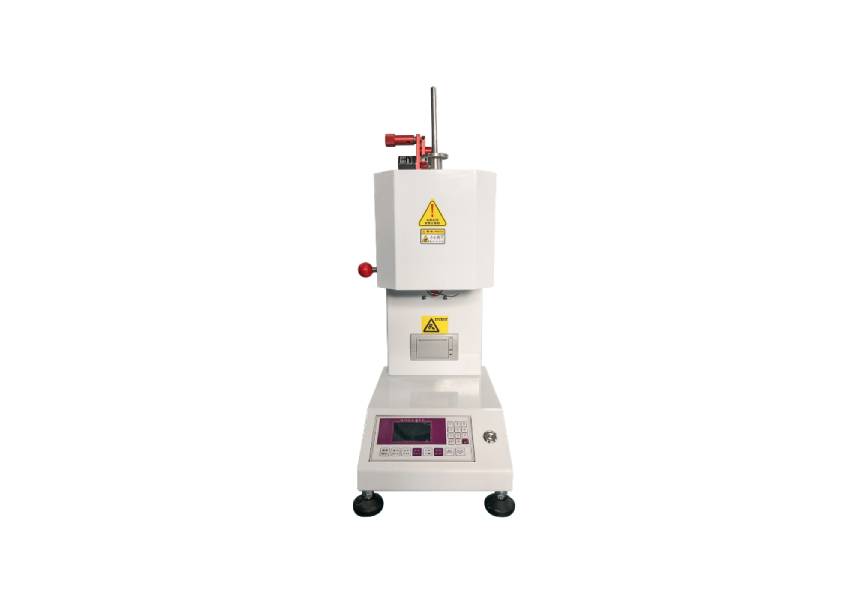
Manual Melt Flow Index testers operate on a straightforward principle. An operator loads the polymer sample into the heated barrel, applies a specified weight on the piston, and manually cuts the extruded polymer at timed intervals. This method aligns with Procedure A testing, where the operator directly measures the mass of extrudate over a set time to calculate the MFI. Manual testers are often favored for their simplicity and lower cost, making them accessible for many labs.
Manual testers shine in labs with low testing volumes or tight budgets. They require minimal technical complexity, making them easy to maintain and operate. For example, small injection molding facilities or specialized masterbatch producers often use manual testers to verify raw materials or monitor batch quality without investing in costly automation. Their durability and reliability suit environments where advanced features aren’t necessary.
Despite their advantages, manual testers have limitations. The accuracy of results depends heavily on the operator’s consistency in timing and cutting the extrudate. Variability can creep in when multiple operators work different shifts, leading to inconsistent data. This human factor can affect repeatability and reliability, especially in high-volume or critical quality control settings where precision is paramount.
Automatic MFI testers automate the extrusion timing, cutting, and data recording processes, following Procedure B testing. They use sensors to detect piston movement and measure flow rates without manual intervention. These machines often come with software for data management, enabling seamless logging and reporting. Automation removes much of the operator variability seen in manual methods.
Automatic testers provide superior repeatability, often achieving less than 2% error compared to manual methods. They boost efficiency by freeing technicians from manual cutting and timing, allowing them to focus on other tasks. Integrated software solutions enhance data management, ensuring traceability and simplifying audits. This automation is especially valuable in industries with rigorous quality demands and high testing volumes.
Automatic MFI testers are ideal for large-scale polymer producers, pipe manufacturers, and sectors like packaging, automotive, and recycling. For instance, a pipe manufacturer running dozens of tests per shift benefits from the speed and consistency of automation. Similarly, recycling operations handling variable resin flows rely on precise, repeatable data that only automatic testers can consistently deliver.
Tip: For labs with multiple operators or high testing volumes, investing in an automatic MFI tester can drastically reduce human error and improve data consistency.
The Melt Flow Index (MFI) tester plays a vital role in plastic manufacturing processes like injection molding, extrusion, and blow molding. It helps manufacturers understand how easily a polymer melts and flows, which is crucial for shaping parts accurately. For example, in injection molding, the polymer must flow smoothly into the mold cavities to form detailed shapes without defects. If the MFI is too low, the polymer might not fill the mold properly, leading to incomplete parts. If it’s too high, the polymer may flow too quickly, causing issues like warping or thin walls.
During extrusion, the MFI value guides the adjustment of temperature and pressure to produce consistent films, sheets, or pipes. Blow molding also benefits from MFI testing by ensuring the polymer melt has the right flow characteristics to form hollow objects like bottles without weak spots or uneven thickness. In all these processes, MFI testing supports process optimization and reduces material waste.
MFI testing is essential across various industries. In packaging, it ensures plastic films, containers, and bottles meet strength and flexibility requirements. For instance, a packaging company uses MFI values to select polymers that can form durable yet lightweight packaging.
The automotive and aerospace industries rely on MFI testing to verify high-performance thermoplastics used in parts like dashboards, bumpers, or interior panels. These parts require materials with precise flow properties to maintain strength and withstand heat or impact.
Medical equipment manufacturers also use MFI testers to ensure plastic components meet strict quality and safety standards. Consistent flow properties help produce reliable, defect-free parts such as syringes, tubing, or housings for devices.
MFI testing guarantees consistency by measuring the flow rate of polymer batches. This consistency is crucial because even slight variations in polymer viscosity can cause defects, poor mechanical properties, or processing difficulties. By regularly testing MFI, manufacturers can detect deviations early and take corrective actions before production.
Consistent MFI values mean predictable processing behavior, which leads to uniform product quality. This reduces scrap rates, rework, and customer complaints. It also helps maintain compliance with industry standards and customer specifications.
MFI testing aids in selecting the right polymer grades for specific applications. Engineers use MFI data to match materials to processing methods and product requirements. For example, a polymer with a high MFI might be chosen for thin-walled packaging, while a low MFI polymer suits structural automotive parts.
Regulatory bodies often require documentation of material properties, including flow characteristics. MFI testing provides standardized, repeatable data that supports compliance with regulations in industries like food packaging, medical devices, and automotive safety.
Tip: Regularly monitoring MFI values helps catch material inconsistencies early, preventing costly production issues and ensuring your products meet quality standards.
Melt Flow Index testing follows strict international standards to ensure reliable, comparable results across labs and industries. The most widely recognized are:
ASTM D1238: The American standard, detailing methods for measuring melt flow rates of thermoplastics. It defines test conditions, machine setup, and reporting formats.
ISO 1133: The global counterpart, providing guidelines on melt flow and melt volume rate measurement. It aligns closely with ASTM but offers broader international acceptance.
Both standards specify temperature, load, and sample preparation to maintain consistency. Using these ensures your MFI values are trusted in quality control and product development.
ASTM D1238 outlines four main testing procedures, each suited for different polymer types or flow characteristics:
Procedure A: The manual method where the operator cuts the extrudate and weighs it over a fixed time. Used for polymers with moderate flow rates.
Procedure B: Automated method using sensors to detect piston movement and calculate flow rate without manual cutting. Ideal for high accuracy and repeatability.
Procedure C: Known as the Half-Die method, designed for polymers with very high melt flow rates. It uses a modified die to accommodate fast-flowing materials.
Procedure D: Multi-weight testing to evaluate flow rate ratios across different loads. This helps analyze rheological properties more comprehensively.
Selecting the right procedure depends on your polymer type and testing goals.
ASTM D1238 also specifies the physical dimensions and construction details of MFI testers to standardize testing conditions:
| Component | Specification |
|---|---|
| Barrel length | 115 mm |
| Barrel diameter | 9.5 mm |
| Die orifice | 2.095 ± 0.005 mm diameter |
| Die length | 8.0 ± 0.05 mm |
| Piston weight | 110 g (standard) |
| Piston foot diameter | 9.55 ± 0.05 mm |
These precise dimensions ensure uniform pressure and flow conditions during testing, minimizing variability.
Calibration and regular maintenance are crucial for reliable MFI results:
Temperature calibration: The barrel temperature must be checked often since even minor deviations affect polymer flow drastically.
Weight verification: Load weights should be periodically weighed to confirm they meet standard mass requirements.
Die and piston inspection: Clean and inspect for wear or damage that could alter flow characteristics.
Software updates and sensor checks (for automatic testers): Ensure data accuracy and machine responsiveness.
Routine maintenance prevents drift in measurements, reduces downtime, and extends equipment life, supporting consistent quality control.
Tip: Schedule regular calibration and preventive maintenance to keep your MFI tester compliant with ASTM and ISO standards and ensure trustworthy, repeatable test results.
The Melt Flow Index (MFI) value depends heavily on several key factors. One of the most important is molecular weight of the polymer. Polymers with higher molecular weights have longer chains that get tangled, making them flow more slowly when melted. This results in a lower MFI value, indicating higher viscosity. Conversely, polymers with lower molecular weight flow more easily, giving a higher MFI.
Temperature during the test also plays a critical role. Increasing the temperature reduces the polymer's viscosity, allowing it to flow faster. Even small temperature changes can cause noticeable differences in MFI results. That's why precise temperature control in the heated barrel is essential for consistent measurements.
Pressure, applied by the piston weight, affects how fast the molten polymer extrudes through the die. Higher weights push the polymer harder, increasing flow rate and MFI value. Different polymers require specific weights as per testing standards to ensure meaningful comparisons.
Additives and fillers mixed into polymers can change how they melt and flow. For example:
Plasticizers make polymers softer and more flexible, often raising the MFI by reducing viscosity.
Fillers like glass fibers or calcium carbonate increase stiffness but can also increase viscosity, lowering MFI.
Reinforcements may create more resistance to flow, affecting extrusion behavior.
These additives can complicate MFI interpretation because they alter flow independently of the base polymer's molecular weight or temperature. Testing must consider these effects to avoid misleading conclusions.
MFI values provide a quick way to gauge polymer flow behavior:
High MFI (above 20 g/10 min): Indicates low viscosity and easy flow. Suitable for processes requiring fast melting and filling, like thin-walled injection molding.
Medium MFI (5–20 g/10 min): Balanced flow properties. Used in a wide range of applications including extrusion and blow molding.
Low MFI (below 5 g/10 min): High viscosity and slower flow. Ideal for structural parts needing strength and toughness.
Understanding these ranges helps manufacturers select the right polymer grade and adjust processing parameters accordingly.
While MFI testing is simple and widely used, it has limitations:
It measures flow at a single temperature and load, providing just one point of viscosity data.
It does not reveal how viscosity changes with different shear rates or during dynamic processing.
Additives or polymer blends can mask true behavior.
Some polymers with very high or very low viscosities may be outside MFI test range.
For a deeper understanding of polymer flow, especially for advanced applications, rheological tests like capillary rheometry or dynamic mechanical analysis are recommended. These provide multi-point data on viscosity, shear behavior, and viscoelastic properties.
Tip: Always control test temperature precisely and account for additives when interpreting MFI results to ensure reliable quality control decisions.
Modern Melt Flow Index (MFI) testers have evolved far beyond simple manual devices. Automation plays a key role in improving test accuracy and efficiency. Automatic testers handle sample extrusion timing, cutting, and data recording without human intervention. This reduces operator errors and ensures consistent test conditions. Digital controls provide precise temperature regulation and real-time monitoring, keeping the polymer melt stable throughout the test. Automated data logging and software integration streamline quality control workflows, making it easier to track results and generate reports.
Advanced MFI equipment often measures more than just the traditional Melt Flow Index. Many systems include Melt Volume Rate (MVR) testing, which calculates the volume of polymer extruded per unit time, offering complementary insights into flow behavior. Some testers also measure shear viscosity, providing information on how the polymer behaves under different shear rates, which is crucial for processing simulations. These multi-parameter capabilities allow labs to characterize materials more comprehensively, supporting better material selection and process optimization.
Cutting-edge MFI testers feature real-time monitoring of extrusion parameters, such as piston position and flow rate, allowing immediate detection of anomalies. Many can integrate with other polymer testing instruments like rheometers or thermal analyzers, creating a holistic material testing environment. This integration enables cross-verification of data and deeper understanding of polymer properties. Real-time alerts help operators quickly adjust testing conditions or halt tests if irregularities arise, improving safety and data reliability.
QualiFi-6000G Auto: Offers fully automated weight lifting, automatic extrusion cutting, and advanced data management software. It supports multiple test procedures and ensures repeatability with less than 2% variance.
Pacorr Digital MFI Tester: Features microprocessor-based temperature control, automated timing, and digital readouts. It supports MFR and MVR testing with easy-to-use software.
Testron MFI System: Combines precision heating, automated piston loading, and integration with rheological analysis tools. It includes touchscreen controls and real-time data visualization.
These examples demonstrate how modern equipment enhances testing speed, accuracy, and data handling, making them indispensable in high-throughput labs and demanding industries.
Tip: Choose MFI testers with automation and multi-parameter capabilities to boost testing accuracy, reduce human error, and gain deeper insights into polymer flow behavior.
Choosing the right Melt Flow Index tester depends largely on your lab's workload, budget, and the precision you need. If your lab runs only a few tests weekly, a manual tester might be cost-effective and sufficient. These devices have a lower upfront cost and are simpler to maintain. However, if your lab handles high testing volumes or requires very consistent, repeatable results, automatic testers offer better accuracy and efficiency.
Accuracy is critical in industries where product quality and regulatory compliance are non-negotiable. Automatic testers reduce human error by automating timing and cutting, ensuring consistent test conditions. Budget constraints also play a role. While automatic testers have higher initial costs, their efficiency and reduced labor can lead to long-term savings.
Manual testers require an operator to manually cut the extrudate and time the test. They fit labs with low throughput or where budget limits automation investment. Manual testers are durable and straightforward, making them ideal for smaller facilities or specialized R&D labs.
Automatic testers, on the other hand, automate extrusion timing, cutting, and data recording. They support higher throughput and deliver more consistent results. Labs in high-demand sectors like pipe manufacturing, packaging, or recycling benefit from automation. For example, an automatic tester can run dozens of tests per shift without operator fatigue affecting results.
Selecting a tester also means considering local support availability and machine durability. Equipment should withstand your region’s environmental conditions, such as heat, dust, or humidity. For instance, labs in the Gulf region or parts of Africa need robust machines designed for such climates.
Local technical support is vital to minimize downtime. Having experts available in your time zone ensures quick troubleshooting and maintenance. This reduces costly delays and keeps your quality control on track.
While manual testers cost less upfront, automatic testers often provide better ROI over time. Automation reduces labor costs, increases throughput, and improves data reliability. This can lead to fewer production errors, less scrap, and better compliance with quality standards.
When budgeting, factor in not only the purchase price but also maintenance, calibration, and software updates. Investing in a reliable, supported system can save money by avoiding frequent repairs or inconsistent data that might lead to production issues.
Melt Flow Index testing ensures polymer quality and consistent production. It helps optimize processes by providing reliable flow data. Advances in automation improve accuracy and efficiency, reducing human error. Future trends include enhanced digital integration and multi-parameter testing. Manufacturers and labs should invest in automated MFI testers for better control and compliance. Guangce Instrument offers advanced MFI testers that deliver precise results and robust support, adding great value to polymer testing needs.
A: A Melt Flow Index Tester (MFI) measures the flow rate of melted polymer by extruding it through a die under controlled temperature and pressure, using components like a heated barrel, piston, and timer.
A: Automatic MFI testers improve repeatability, reduce human error, and increase testing efficiency by automating extrusion timing, cutting, and data recording.
A: Precise temperature control in an MFI tester is crucial because small variations can significantly impact polymer flow and the accuracy of MFI results.
A: Costs vary based on automation level, testing volume needs, accuracy, and included software; automatic MFI testers are more expensive but offer better efficiency and data management.
A: Regular calibration, maintenance of the heated barrel, piston, and die, along with software updates, ensure accurate and consistent MFI test results.


